By Annie Brooks
Beeton prints these as captions beneath the engravings, so each entry is short and each is really a counting rule: so many buttonhole stitches worked, so many missed, and where the next row starts.
Don't lose this article. Enter your email below, and I'll send it to you right now. Plus a little crochet inspiration from me, straight to your inbox.
Fillings built on point d’Espagne
No. 439.—Treble Point d’Espagne — is worked in exactly the same way as the open and close point d’Espagne, as may be seen in illustration No. 439. Three close stitches, one open, three close to the end of each row. Sew back, and in the next row begin one open, three close, one open, then close to the end; repeat the rows as far as necessary, taking care that the close and open stitches follow in
No. 440.—Point de Grecque — is begun from left to right is worked backwards and forwards, and is begun by one stitch in loose point de Bruxelles and three of close point d’Espagne; then one Brussels, three point d’Espagne to the end of the row; in returning work back in the same manner.
No. 441 — at the left hand and work six point de Bruxelles stitches at unequal distance, every alternate stitch being larger. 2nd row: Upon the first large or long stitch work 9 close button-hole stitches, then 1 short point de Bruxelles stitch under the one above, then 9 close stitches, and so on to the end of row (right to left). 3rd row: 5 close button-hole in the 9 of previous row, 1 short point de Bruxelles, 2 close in the Bruxelles stitch, 1 short point de Bruxelles, 5 close, 1 short point de Bruxelles, 2 close, 1 short, 5 close, I short, and repeat. 4th row: 5 close, 1 short point de Bruxelles, 2 close, I short, 5 close, I short, 2 close, I short, and repeat. Continue the rows until sufficient of the pattern is worked.
The lightest fillings
No. 442.—Point d’Alençon — This stitch is used to fill up narrow spaces where great lightness is required. Point d’Alençon is worked under and over in alternate stitches, like hem stitch. Nos. 442 and 443 show point d’Alençon. In No. 442 a twisted stitch is worked over the plain point d’Alençon, which is clearly shown in No. 443; this twist is made by passing the thread three times round each plain bar, and working the knot shown in illustration No. 442 over both strands of the bar.
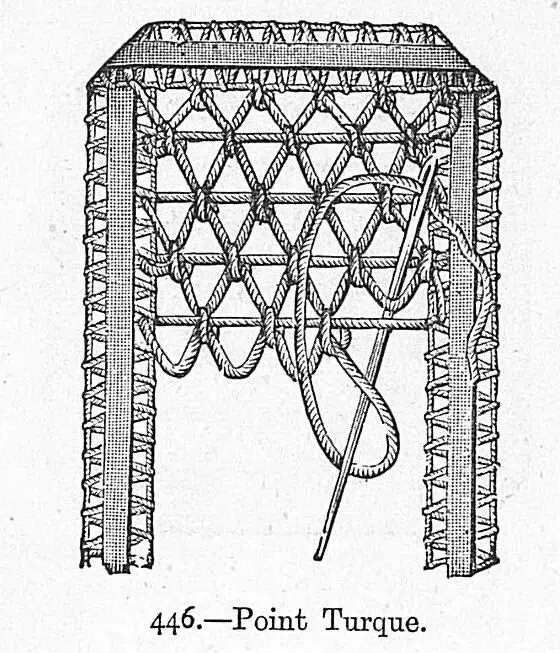
No. 446.—Point Turque (Turkish Stitch) — This easy and effective stitch looks well for filling either large or small spaces; the thread employed should be varied in thickness according to the size of the space to be filled. 1st row: Work a loop, bringing the thread from right to left, passing the needle through the twist and through the loop, draw up tight and repeat. 2nd row: I straight thread from right to left. 3rd row: Work the same as first, using the straight thread in place of the braid.
No. 448.—Point de Reprise — This stitch is worked by darning over and under two threads, forming a triangle. The space is filled by parallel and crossway bars, placed at equal distances, and on the triangles thus produced point de reprise is worked.
No. 449.—Point Brabançon — is worked as follows:— Left to right. 1st row: 1 long loose, 1 short loose, point de Bruxelles alternately to end of row. 2nd row: 7 tight point de Bruxelles in the 1 long loose stitch, 2 short loose point de Bruxelles in the short loose stitch of previous row, repeat. 3rd row: Same as first.
Grounds, and two named laces
No. 452.—Point de Tulle — This stitch is used as a groundwork for very fine work, and is worked in rows backwards and forwards in the same stitch as open point d’Espagne, page 457.
No. 453.—Mechlin Lace — This is one of the prettiest stitches in point lace, but also one of the most difficult to work correctly. It is thus worked: — Work a number of diagonal bars in button-hole stitch on a single thread in one direction, then begin in the opposite side the same way, and work 5 or 6 stitches past the spot where the two lines cross, pass the thread round the cross twice under and over the thread to form a circle.
Don't lose this article. Enter your email below, and I'll send it to you right now. Plus a little crochet inspiration from me, straight to your inbox.
Work in button-hole stitch half one quarter, make a dot by putting a fine pin in the loop instead of drawing the thread tight, and work 3 button-hole stitches in the loop held open by the pin, then take it out, and continue as before.
No. 454.—Escalier Lace — This useful lace may be varied in pattern to any extent by placing the open stitches in any desired order; it then takes the name of diamond or Antwerp lace, according to the design. True escalier lace is made by working nine button-hole stitches close together; then miss 3 — that is, work none in the space that 3 stitches would occupy — work 9, miss 3 as before to the end of row, begin the 2nd row 3 stitches from the end, to cause the open spaces to fall in diagonal lines— a succession of steps or stairs (escalier), which gives this stitch.
Spanish Lace — scrolls, flowers, &c. This is effected by working over an underlay of coarse white thread or over fine white linen cords. The wheels are worked by winding soft coarse linen thread round pencils or smooth knitting-pins of various sizes, and working over the circle thus obtained a succession of close button-hole stitches.
These wheels are sewn on to the lace when completed. The groundwork of Spanish lace is usually worked in what are called Raleigh Bars (see page 477), but this lace has sometimes for groundwork point de Venise. An easy mode of working this handsome lace is to trace the design upon very fine good linen; raise the thick parts as above directed, and embroider the whole in fine thick scalloped button-hole stitch; fill the ground with Raleigh bars, or, as shown in illustration No. 455, in treble point de Venise, and cut away the linen from beneath the groundwork.
This is one of the prettiest stitches in point lace, but also one of the most difficult to work correctly.
| Filling | The count the entry gives | What it is for |
|---|---|---|
| Treble point d’Espagne | 3 close, 1 open, 3 close to the end; the next row 1 open, 3 close, 1 open, then close | |
| Point de Grecque | 1 loose point de Bruxelles, 3 close point d’Espagne, repeated; worked back the same way | |
| No. 441 | Row 2: 9 close on each long stitch, 1 short between. Row 3: 5 close, 1 short, 2 close, 1 short | |
| Point d’Alençon | Under and over in alternate stitches, like hem stitch; the twist passed three times round each plain bar | Narrow spaces where great lightness is required |
| Point Turque | A loop drawn tight through the twist and the loop; alternate rows worked on a straight thread | Large or small spaces |
| Point de Reprise | Darning over and under two threads to form a triangle | The triangles between parallel and crossway bars |
| Point Brabançon | Row 1: 1 long loose, 1 short loose alternately. Row 2: 7 tight in the long, 2 short loose in the short | |
| Point de Tulle | Worked as open point d’Espagne, then gone over a second time under each twisted bar | Groundwork for very fine work |
| Mechlin Lace | Diagonal buttonhole bars both ways; 5 or 6 stitches past the crossing, thread twice round the cross, 3 stitches in the pinned loop | |
| Escalier Lace | 9 buttonhole stitches close together, miss 3; each row begun 3 stitches from the end | |
| English Wheel | The needle under each bar, out between the thread and the last stitch |
The wheels
The Sorrento Wheel — This is worked by fastening the thread in the pattern to be filled up by means of the letters. Fasten it first at the place *, then at place b, carrying it back to the middle of the first formed English lace. See page 462, and illustrations Nos. 456 and 457.
No. 458.—English Wheel — This is worked in the same manner as the Sorrento wheel, but instead of winding the thread over and under the bars, the needle is inserted under each bar and brought out again between the thread and the last stitch. This gives a kind of button-hole stitch, and gives the square, firm appearance possessed by this wheel.
No. 460 — No. 460 is a rosette or star which is used to fill circles of braid, and forms the centre of many modern point lace patterns.
Source
Mrs Beeton, Beeton’s Book of Needlework (1870). Public domain. Internet Archive krl00402947.
Reproduced verbatim from the scanned original. Obvious scan errors (broken letters, words split across a line) have been mechanically corrected; nothing has been rewritten or modernised. Beeton prints these entries as captions to engravings, and several break off where an engraving stood; those broken fragments have been left out.