By Annie Brooks
Puffings are bands of material gathered along both edges and set on a skirt or a sleeve. The entry is mostly a question of arithmetic: how long a strip each kind of stuff needs before it is drawn up.
Don't lose this article. Enter your email below, and I'll send it to you right now. Plus a little crochet inspiration from me, straight to your inbox.
When the gathering goes wrong
Puckering — A term used in reference to Needlework, both plain and decorative. It signifies the drawing-in of one side of two pieces of material tighter than the other, in reference to plain sewing; and in the execution of embroidery, it denotes a drawing of the surface of the material in and out, so as to make it uneven, by the irregularity with which the embroidery threads are drawn — some loose, some tight. It may also arise from using too coarse a thread for the closeness of the material to be embroidered.
What a puffing takes
Puffings — Bands of any material, cut either straight or on the bias, and gathered on both sides; used as headings to flounces, round the sleeves, or down them. In olden times they were much in fashion for the dress of both men and women. The method of making these, like everything else, depends on the current fashion.
At one time Puffs are made on the cross of materials, and at another, even those that are transparent, are invariably cut on the straight; and this from the length, not width, way of the stuff. The proportion, however, is the same, for both Tarlatan net and Tulle require as much again as the space they are to cover — i.e., a skirt 4 yards needs a strip of 8 yards for the Puff.
Grenadine and silk gauze, being slightly more substantial, do not need quite as much; and for thick, opaque fabrics, half as much again as the foundation is sufficient.
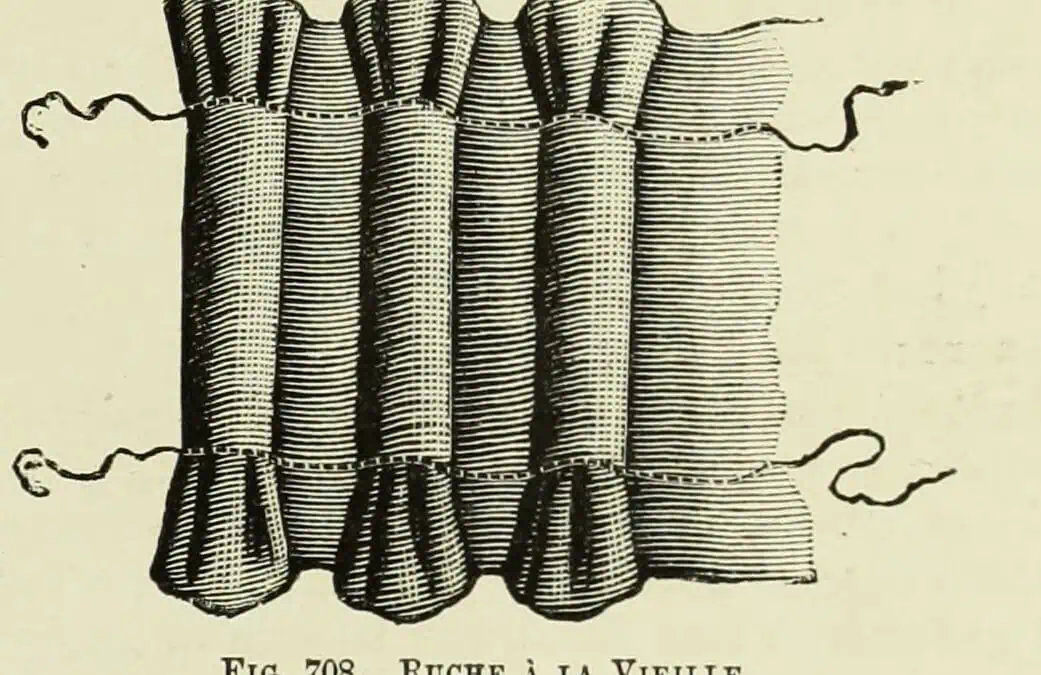
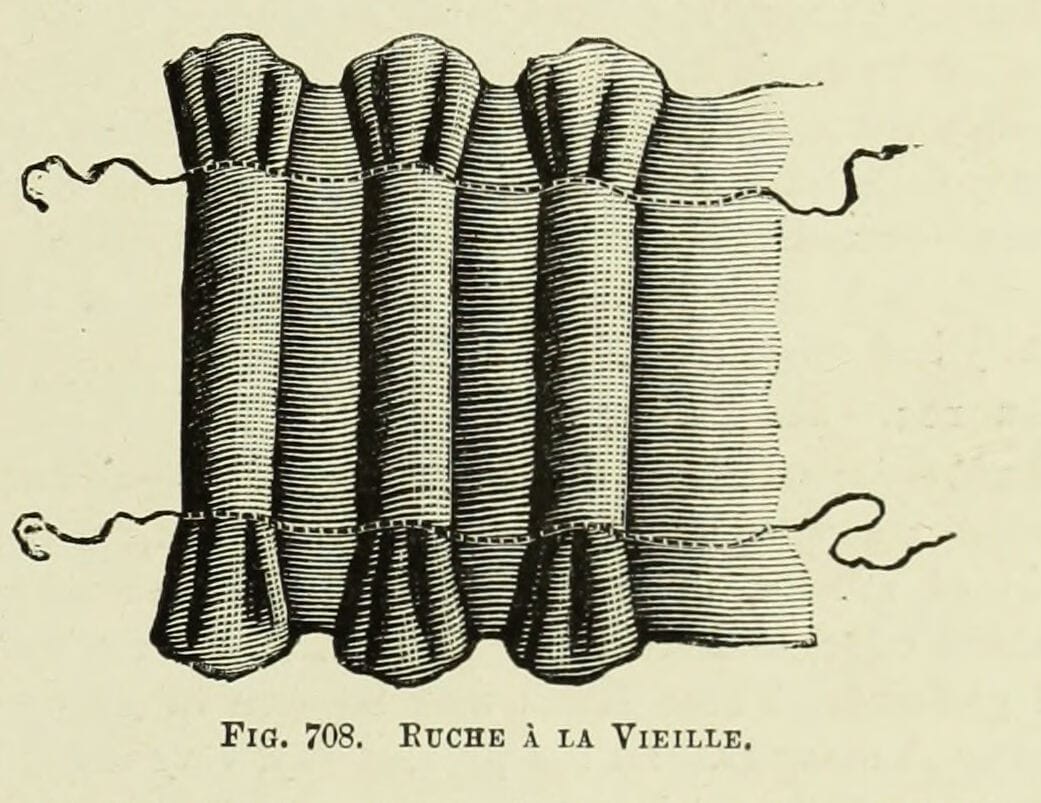
On a gored skirt — When skirts are much gored it is impossible to make a group of Puffs; but you may divide every two with a ruche, or other device, to admit of cutting the Puffs asunder, so as to lessen the length for the upper ones. If all were made at once, by a series of Runnings on one width of stuff, the top Puffs on a gored skirt — which is, of course, narrower as it goes upwards — would be by so much the fuller than the Puffs nearer the Hem, and the effect would be very clumsy, as the trimming should be lighter above than below.
The proportion, however, is the same, for both Tarlatan net and Tulle require as much again as the space they are to cover — i.e., a skirt 4 yards needs a strip of 8 yards for the Puff.
| Material | Strip needed |
|---|---|
| Tarlatan net | As much again as the space it covers — a 4-yard skirt takes an 8-yard strip |
| Tulle | As much again as the space it covers |
| Grenadine | Not quite as much |
| Silk gauze | Not quite as much |
| Thick, opaque fabrics | Half as much again as the foundation |
Running them on
Crossway puffs — Run crossway Puffs straight along a creased mark, and Tack the thread, when drawn up, lightly down to the foundation. Fold the skirt into four, and put a pin at each quarter; fold the strip into foui’, and do the same. Run a thread from pin to pin, fixing one on the Puff, to one on the skirt, at each division.
Then, while spread over the corner of a table, far enough in to distend a quarter at a time, pull up the drawing thread, twist it round the pin, equalise the fulness with a needle, and secure it with pins every few inches. Every quarter being so arranged, turn the skirt inside out, and Run along on the inside, to sew the Puff to the dress, which is seen through.
Don't lose this article. Enter your email below, and I'll send it to you right now. Plus a little crochet inspiration from me, straight to your inbox.
Fulling bouillionces — Puffs that seem to hang over at the bottom are called ” fulling bouillionces.'” Crease them down on the wrong side, and make a Running a little way in, while still creased, so as to take up the material double. Sew each succeeding row, made on one piece, to the skirt by Running the inside of the Puff, to the right side of the dress, the creased edge lying upwards.
The topmost Puff may have the edge turned down. Make a Running, so as to gather it up into a little frill heading. Puffs on the straight, not meant to hang downwards, as above, may not show the gathering thread; Crease them on the inside, and Whip them scantily over.
Upright puffs — Upright Puffs are never much in use as skirt trimmings when gored dresses are in vogue, as the upper portions of them would project more than the lower. They do not look well unless fully as much again be gathered as the height they are to reach. Mark the portion of the skirt to be covered into spaces, by placing a pin at each division.
Make the Runnings on the length of the material, secure the top of each Running to one of the pins, and draw the thread even with the skirt, twisting the loose end round a pin, opposite that of the top. As every two or three are so far arranged, distribute the fulness along the thread with tolerable equality, but more towards the lower part.
Make a Running down the lines, and then continue the rest. Close the openings of the Puff at the bottom, by using the width in little plaits in the middle of the Puff; and draw the tops upwards, chiefly in the centre, and sew them there. Make a series of semicircles thus; presuming that no other trimming surmount them.
If tiny Puffs be used for entire plastrons, from throat to feet, make them on one piece of material, and that on the selvedgeway; as widthway or crossway would show so many joins. When making them of such great length, cut off the quantity, and Baste a line at every third or quarter, and also on the lining, or dress to be covered; then make the Runnings, ending them at every Basting, and fix them, division by division, beginning at the top one.
Source
S. F. A. Caulfeild and Blanche C. Saward, The Dictionary of Needlework. Public domain. Internet Archive dictionaryofnee05caul.
Reproduced verbatim from the scanned original. Obvious scan errors (broken letters, words split across a line) have been mechanically corrected; nothing has been rewritten or modernised. The Puffings entry itself carries no engraving; the ruche shown is from the same volume, and is the trimming the entry names as a divider between puffs.