By Annie Brooks
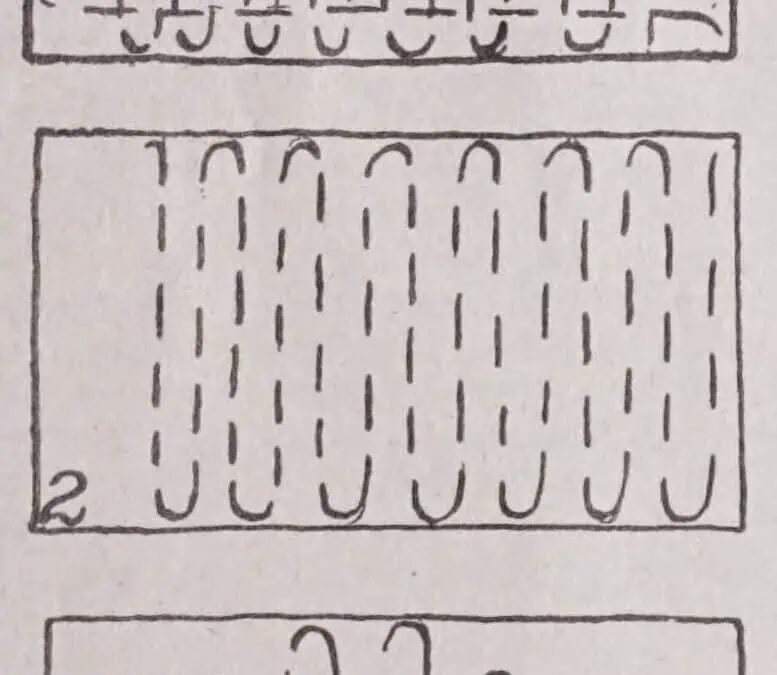
A darning lesson from an American women’s handbook, set out darn by darn against thirteen numbered diagrams. Three of those diagrams are reproduced here; the rest stayed on the page.
Don't lose this article. Enter your email below, and I'll send it to you right now. Plus a little crochet inspiration from me, straight to your inbox.
What a darn is for
The object of darning is to replace worn places in material by inserting new threads. These new threads should be as nearly like the originals as possible, in quality, size and kind. All darnings, excepting Swiss and stocking web darning should be worked on the wrong side. There are six different kinds of darns: plain, running, damask, (which is divided into two classes, plain and twill), Swiss, hedge or catch, and cross cut.
These new threads should be as nearly like the originals as possible, in quality, size and kind.
| Darn | What it repairs | Which side it is worked on | Its distinguishing mark |
|---|---|---|---|
| Plain | holes, as in stockings | wrong side | warp threads first, then weft carried over and under |
| Running | worn places where no real hole is | wrong side | rows of running thread side by side, the way of the warp |
| Damask, plain | damask articles | wrong side | the design formed by which threads the weft takes up |
| Damask, twill | diagonally woven material | wrong side | one thread taken up, three or four crossed over |
| Swiss | a weak place in knitted articles | right side | a copy of a plain or purl knitting stitch; no stranding |
| Stocking web | a hole in knitted articles | right side | the same stitch, worked over stranding threads |
| Catch or triangular | a tear like two sides of a square | not stated | running darn stitches drawn along each side of the tear |
The darns
Plain darning — is employed for holes, as in stockings. The hole may be left as it is, or cut evenly to a square or oblong shape, but all frayed edges should be trimmed. The warp threads are inserted first, with a small margin of running stitches around the edge of the hole to hold the darn, and to strengthen the material around it.
Then the weft threads are added, each one carried alternately over and under the warp threads, forming a sort of interlacing or lattice eflfect. Each thread is preceeded and ended by a few running stitches, and a loop of thread is made at the end of each row, to allow for shrinking in washing.
Running darns — are worked by placing a certain number of rows of running thread, side by side, worked on the wrong side. In every alternate row the same threads are taken up on the needle. The use of running darns is to strengthen worn places where no real hole is. It is best in running darns to put the threads in, the way of the warp, if possible.
Small loops should be left at the end of each row. The number of threads left between each two rows of threads should be the same as those taken up for each stitch. These darnings are usually square for firm materials, while for thin fabrics, the threads are worked in diamond or irregular outline. When worked so that the ends of each row of threads form a point or an irregular figure, the strain does not come repeatedly on a few threads.
Damask darning — is a form of plain darning, used on damask articles. There are two kinds, plain and twill. The work may be done with good embroidery cotton, and is like the ordinary darning as regards the warp threads. The design is formed by taking up, and gping over a number of threads when putting in the weft threads.
It is good to make a small drawing of the design on transparent paper, and to indicate by dots the threads to be taken up. The non-marked spaces will indicate the threads which the needle is to cross.
Don't lose this article. Enter your email below, and I'll send it to you right now. Plus a little crochet inspiration from me, straight to your inbox.
Twill darning — for material woven diagonally, is worked by taking up one thread; and crossing over 3 or 4, and in each row this thread is worked to the left or right of the foregoing one, as the weave may require.
Swiss and stocking web darns — Swiss darns, and stocking web darns are similar, excepting that the former is used to strengthen a weak place in knitted articles, while in stocking web a hole is darned. The stitch used is firm and elastic when finished, and also invisible. It is an accurate copy of a plain or purl knitting stitch.
It is commenced at the lower right-hand corner, and worked on the right side. When working a hole the threads should be unpicked at top and bottom to make the opening square or oblong. The loose edges at the sides should be turned under until the work is done. The stranding requires one more stitch at the top than at the bottom, i. e., if the bottom has 10 stitches, the top should have eleven, and yet when finished both should have an equal number of stitches.
To overcome the difficulty, have 9 whole stitches at the bottom, and stitch at each side of the nine. Then begin working at the lower right-hand corner, through the half stitch at the top right-hand corner, then through the whole stitch to the left of this, backthrough the first lower stitch, up through the next, and continue so, until all is finished.
Care should be taken to begin and end respectively at the lower right and left-hand corners. Where it is necessary to narrow according to the shape of the garment, two stitches may be caught together. (In the Swiss darn the stitch is the same, but stranding is not required, as there are no holes, and the threads are only worked over each stitch in the worn part.) Each row of stitches should be strengthened at the sides and each stranding thread cut and pulled out separately when working the last row. When finished the ends are secured, and loose material trimmed.
Catch or triangular darning — is used on dresses and aprons, when such garments are caught on sharp objects and produce a tear that looks like two sides of a square. The tear is gently drawn together with the running darn stitch. Five or more stitches are made on each side of the tear, continued to the corner, then worked on the opposite side in the same way.
Or — a stronger way — each side may be continued down to the outer margin of the stitches to make a complete square corner.
Source
Home Craft: The American Woman’s Handibook. Public domain. Internet Archive homecraftamerica00unse.
Reproduced verbatim from the section headed “All About Darning”. Obvious scanning errors have been mechanically corrected, and one line the scanner dropped has been restored from the printed page; the page’s closing paragraphs, which turn to brushing and hanging clothes, are not included. The diagrams are the book’s own.