By Annie Brooks
A run of consecutive entries from an 1880s needlework encyclopaedia, reproduced as printed. It defines four kinds of treble and six kinds of tricot, and names the hook, the wool and the finished article for each.
Don't lose this article. Enter your email below, and I'll send it to you right now. Plus a little crochet inspiration from me, straight to your inbox.
The treble family
Treble Stitch, Cross — Take the cotton twice round hook, and put it into the Foundation next to stitch last worked, take cotton once round hook and draw it through as a loop, take on more cotton and draw it through two loops on the hook, which will leave three still there, wind cotton once round the hook and put the hook into Foundation, 2 stitches from last insertion and draw it through forming a loop, thus having five loops on hook ; take up cotton and work off two loops at a time until only one remains, make 2 Chain and make 1 Treble into the upper cross part of stitch, and repeat for the next cross Treble.
Treble Stitch, Double Long — A variety of Treble Crochet, but where the cotton in Treble the first time is wound once round the hook, in Double Long Treble it is wound three times, and cast off with the worked stitches one by one. It is but little used in Crochet, as the stitch formed by so many castings off is too long for anything but coarse work. Abbreviation in Crochet instructions ” d, 1. 1,’
Treble Stitch, Long — A variety of Treble, in which the cotton is wound twice round hook, and cast off with the worked stitches one by one, thus making a longer stitch than ordinary Treble. To work : Wind cotton twice round hook and insert into Foundation Crochet, draw through, wind cotton once round, and draw through two loops, wind cotton once round and draw through two loops, wind cotton once round and draw through two loops, wind cotton once round and draw through last two loops. Abbreviation in Crochet instructions, “L. T.” See Treble.
Treble Stitch, Raised — Work three rows of Ribbed Stitch. Fourth row — work 2 Ribbed Stitches, and make a Treble for next, putting the hook into the stitch underneath it of the first row, work 2 Trebles in this way, then 2 Ribbed Stitches, then 2 Trebles, and continue to the end of the row.
Fifth row— turn the work and work a row of Ribbed Stitch. Sixth row — commence with the 2 Trebles, putting them into the third row beneath the stitch, and continue to work 2 Ribbed and 2 Trebles to end of row. Seventh row— like fifth. Eighth— like sixth, and so on to end of pattern, By working the A variation of this stitch is shown in Fig. 238, in which one Raised Treble is taken up the work in diagonal lines.
As this arrangement does not allow of the work being turned, commence each row on the right hand side, or work the whole round. Commence with Foundation Chain and two rows of Double Crochet. Third row — work Treble Crochet between every third Double Crochet ; take it over the lines already made, as described in the first pattern, and put it in, by the arrow; in the next row work as before, only putting the first Treble in the stitch beyond the one worked in the previous row. Always work 3 Double Crochet between each Raised Treble.
| Entry | Cotton round hook | Abbreviation | The book’s verdict |
|---|---|---|---|
| Treble | once | — | the base stitch the others vary from |
| Treble, Long | twice | “L. T.” | “a longer stitch than ordinary Treble” |
| Treble, Double Long | three times | “d. l. t.” | “too long for anything but coarse work” |
Tricot, and its other four names
Tricot Stitch — Also known as Tunisian Crochet, Railway, Fool’s, and Idiot stitch. The easiest of Crochet stitches, but only suitable for straight work ; it is usually worked with Berlin or fleecy wool, and a wooden hook, No. 4, and is suitable for couvrepieds, counterpanes, muffatees, mufflers, and other warm articles. The hook must be sufficiently long to take the length of the work upon it at one time, and when large pieces are required work them in strips and sew together so as to render them less cumbersome while in progress.
To work : Make a Foundation Chain of the required length with 1 Chain over for second row, put the hook through the second Foundation Chain, and make a stitch, leave it on the hook, pick up the third Foundation Chain, make a stitch, and leave on the hook, continue until all the Foundation stitches are picked up, made, and on the hook.
Third row — wool over the hook, which draw through 2 loops, wool over and draw through the next 2, and so on to the end of the row. Fourth row — upon the work will now be visible a number of long upright loops, put the hook through the first of these and make a stitch, leave it on the hook, and continue to pick up loops, make them and keep them on the hook to the end of the row.
The rest of the work is third and fourth row alter- nately. Be careful to count the number of stitches on the hook from time to time, as the end loops are frequently overlooked. The work can be increased in any place by a stitch made at the end and narrowed by two stitches being looped together.
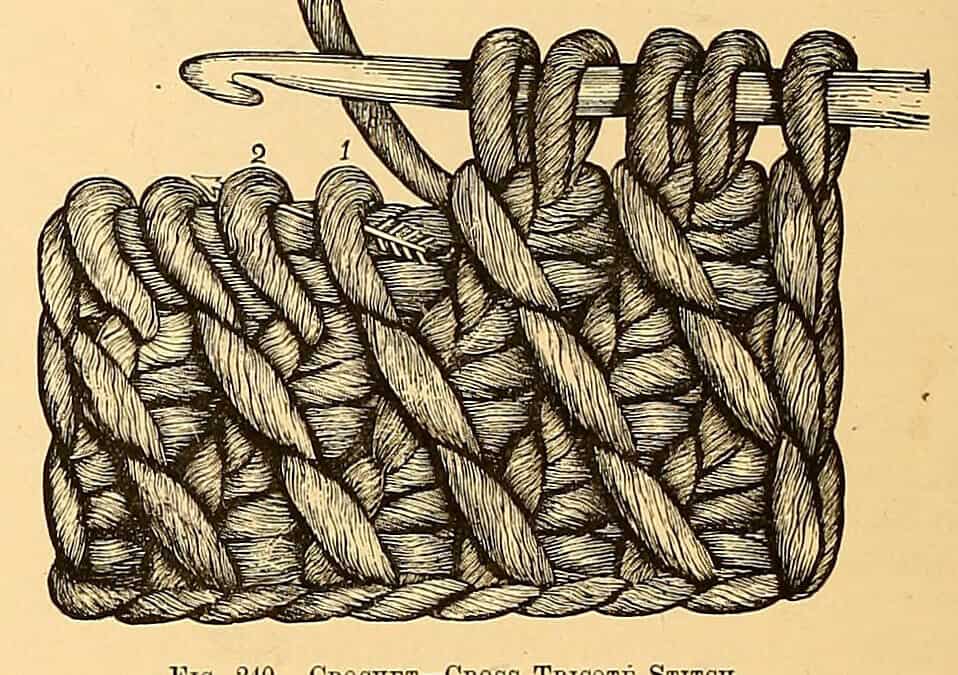
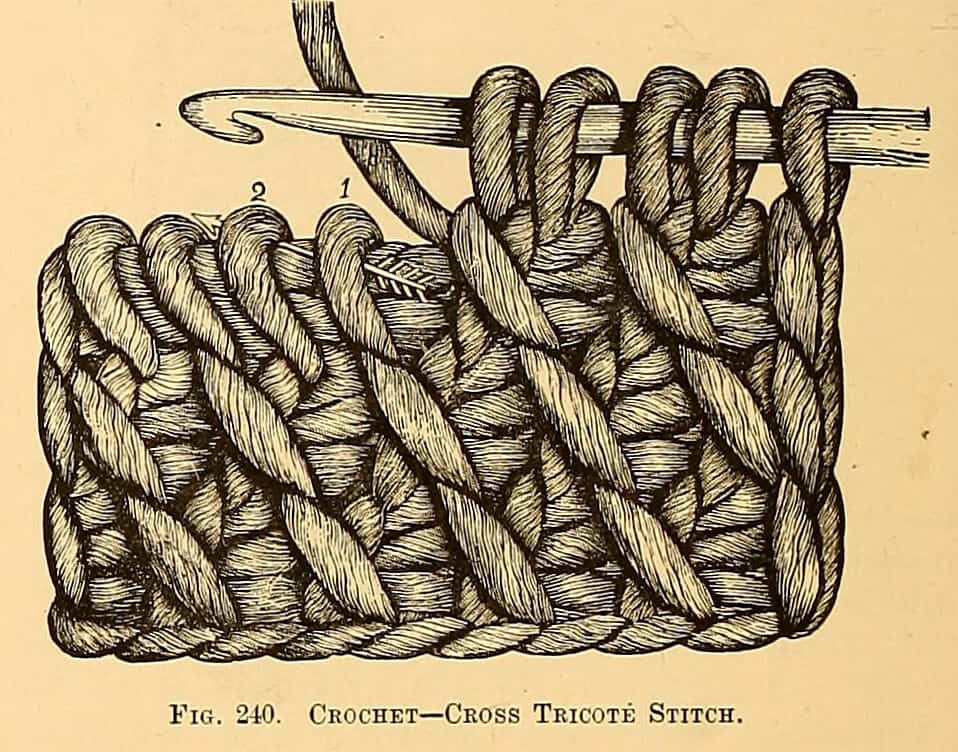
Tricot Stitch, Cross — This stitch, worked with a fine bone hook and in single wool, is a close, useful one for comforters and muffatees, and with a large hook and fleecy wool makes good couvrepieds or crossover shawls. It is a variation of ordinary Tricot, in which the second stitch is crossed under the first and worked before it.
Make a Foundation Chain of width required, and work a row of Tricot which take back in the usual manner. Second row — work the Edge Stitch plain, then take out hook and draw the second loop through the first, by the direction of the arrow and the figures 2 and 1, work the loop number 2, and retain it on hook and then the loop number 1, which also retain (see illustration) ; continue to the end of the row, working the last stitch like the Edge stitch plain, return back as in Tricot.
Don't lose this article. Enter your email below, and I'll send it to you right now. Plus a little crochet inspiration from me, straight to your inbox.
In the next row the Cross stitches will not come under the ones below them, but will be altered in position. Work the first loop on the row without crossing it, and turning the loop next to it over the first loop of the second cross, thus working together the two stitches away from each other instead of the two close together; these two lines constitute the whole of the work.
Tricot Stitch, Ecossais — Commence by making a Foundation Chain of eleven stitches, keep the loop on the hook, the wool being at the back of it, bring the wool over the hook to the front, and leave it at the back, put the hook into the last Chain Stitch but one, and bring the wool through in a loop.
There will now be three loops on the hook, put the hook into the next Chain Stitch, bring the wool through in a loop, put the hook into the next Chain, and bring the wool through. There will now be five loops on the hook. Hold of the second of these five loops with the finger and thumb of the left hand, turn it over the other three loops at the back, and raise three loops from the three upright stitches of those which appear tied together.
Then turn the loop made on the hook over these three loops, repeat from the commencement of the row twice more, and at the end put the hook into the last stitch and raise one loop ; work back as in the first row. Repeat the second row until the length is made. Tricot Stitch, Fancy
(1) — An arrangement of Tricot by which perpendicular loops are formed. It is worked with the usual Tricot wooden hook and with fleecy or Berlin wool, and is useful for comforters and petticoats, as it makes a warm, close stitch. Make a Foundation Chain of the width required and work a line of Tricot, which take back, first stitch through one loop and all the rest through two.
Second row — instead of picking up the loops, as in Tricot, push the hook through the stitch below the horizontal line and out at the back, as shown by the arrow in Fig. 242 ; take up the wool, draw it through to the front, and leave it on the hook. Repeat to the end of the row, and work back as described before.
(2) — This is a pretty stitch for handkerchiefs, shawls, &c, or as a stripe for a blanket. Cast on a Foundation Chain the length required. First row— raise all the loops as in Tricot, and work back very loosely. Second, or pattern row — keep the wool to the front of the work, take up the little stitch at the top of the long loop without drawing the wool through, put the hook from the back of the work between the next two loops, draw the wool through to the back across the long loop, pass the stitch thus formed into the one above the long loop without taking the wool on the hook again, take up the next small stitch above a long loop (the wool should be still in front), insert the hook from the back between the next two long loops, draw the wool to the back, and pass this stitch into the last raised, continue to the end, work back in the usual way very loosely, and repeat the second row.
(3) — This stitch is useful for petticoats and muffatees, as it is thick and close. It requires a bone hook and single Berlin or fleecy wool. Make a Foundation Chain eight inches long, take up all the loops as in Tricot, and work back. Second row — take up the Chain between the first and second perpendicular loops, draw the wool through, put the hook through the second long loop (shown by the arrow in Fig. 244) into the third loop (shown by dot), and draw the third loop through the second which crosses them; then draw the wool through the third loop, which is now on the hook, * take up the next Chain after the third loop; then cross the two next long loops, and draw the wool through the last ; repeat to the end of the row ; work back in Tricot. Third row — Tricot. Fourth — like the second. Continue these two rows to the end of the work.
(4) — A variety of Tricot, and worked thus: Make a Foundation Chain the width required and take up all the stitches, and work them off one by one for first row, as in Tricot. Second row — * thread round hook, pick up two stitches together, repeat to end of row from * until the last stitch, which pick up singly; this is the row shown in
Tricot Stitch. — Also known as Tunisian Crochet, Railway, Fool’s, and Idiot stitch.
| Variant | Hook | Wool | What it was made into |
|---|---|---|---|
| Tricot (plain) | wooden, No. 4 | Berlin or fleecy | couvrepieds, counterpanes, muffatees, mufflers |
| Tricot, Cross | fine bone | single wool | comforters, muffatees |
| Tricot, Cross | large | fleecy | couvrepieds, crossover shawls |
| Tricot, Ecossais | not stated | not stated | not stated |
| Fancy Tricot (1) | wooden Tricot hook | fleecy or Berlin | comforters, petticoats |
| Fancy Tricot (2) | not stated | not stated | handkerchiefs, shawls, blanket stripes |
| Fancy Tricot (3) | bone | single Berlin or fleecy | petticoats, muffatees |
| Fancy Tricot (4) | not stated | not stated | not stated |
Source
Sophia Caulfeild and Blanche Saward, The Dictionary of Needlework: An Encyclopædia of Artistic, Plain, and Fancy Needlework. Public domain. Internet Archive dictionaryofneed001caul.
Entries reproduced verbatim in their original order. Obvious scanning errors have been mechanically corrected; wording, spelling and punctuation are otherwise as printed. The engravings are the book’s own.