By Clara June
Cornelia Mee published this in 1845, when crochet instructions were still being written down for the first time. Her central rule is a small one and easy to miss: the colour changes halfway through a stitch, not between stitches.
Don't lose this article. Enter your email below, and I'll send it to you right now. Plus a little crochet inspiration from me, straight to your inbox.
Increasing, and where a bead falls
To increase — To increase in crochet, make 2 and sometimes 3 stitches in one loop.
Beads — Putting beads on the right side of crochet is only desirable where you are working a pattern in coloured silks at the same time with them (as it is more troublesome to do). Where the pattern is wholly composed of beads, it is best to thread the beads, raise a bead, and pass it up to the needle, insert your crochet, and draw the silk through, and again through the 2 loops on the needle. This brings the bead on the contrary side to the right, when working patterns.
The chain, and how to hold the hook
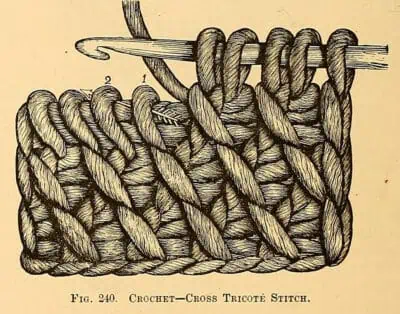
The chain — First make a chain, by making a loop, and drawing one loop through the other, till it is of sufficient length; this forms a foundation, and all crochet work must be begun in this way; then pass your crochet through the end loop, and, taking up the wool or silk, draw it through; repeat this in every successive loop to the end of the row; then turn it, taking the under loop, and continue backwards and forwards in the same way.
This forms a ribbed kind of crochet, and is the most simple to begin with: the appearance of both sides is the same.
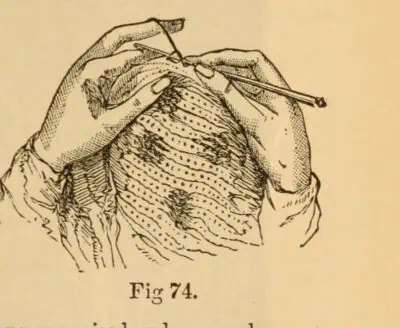
Holding the hook — Great care should be taken to hold the crochet properly, for it is impossible to become expert in the work without this is attended to. It should be held much as a pen, and after the foundation is made the work must be taken between the fore-finger and thumb, and the silk, wool, or cotton, you may happen to be working with, passed over the fore-finger, and then under the 2d and over the 3d.
The point of the crochet must always be put under the silk or wool before drawing it through. The accompanying explanations will, it is hoped, illustrate the best method of holding the crochet An ivory crochet for beginners is preferable, though an experienced worker will generally find that a steel one makes the stitches more even, and is in most respects better.
Carrying a second colour
Double Crochet — This may be worked round and round, or in rows; if the latter, you must always break off at the end of every row, as it cannot well be done backwards and forwards, especially if intended to have a pattern on it. After the foundation is made, you will have one loop on your needle; insert the crochet through the next, and then draw your wool or silk through both; this still leaves a loop on your crochet, keep this on it, and draw your wool through the next loop, and then through both.
When you come to the end of a row, draw the wool through the last loop and cut it off, leaving an end of about 3 inches.
Introducing colours — In introducing colours, you must begin with the ground, drawing the wool through the loop, and then passing the short end through; you must pass your forefinger between the wools you are using, keeping the one you are working with at the top; put your crochet under the wool you are not working with, the 1st part of the stitch, and over it the 2d; this conceals the wool, and carries it on till you require to use it
The half-stitch rule — To make a pattern correct in crochet, a half stitch at each end is always required, and this not being attended to makes the pattern appear aside; therefore, for instance, if the pattern you are working requires 8 stitches of a ground of claret and 3 of a pattern of green, you must work the 7 stitches of the ground of claret and the 1st part of the 8th stitch, and draw the green through the last part; work 2 stitches of the green and the 1st part of the 3d stitch, and draw the claret through the last; work 7 stitches of claret and the 1st part of the 8th, and so on.
By the 2 half-stitches, 1 at the beginning and the other at the end, you make up the right number of stitches: and whatever number you require this must be remembered, that 1 stitch less, and the halfstitch at each end, make up the proper quantity of stitches wanted.
Beads instead of a colour — If silk is used for this stitch, and beads put on instead of a different colour, the number of beads must be threaded on the silk, as the pattern may require; but beads cannot easily be put on what is usually considered the right side of crochet. Raise a bead, and put it close to the loop you have on the crochet, draw the silk through the next loop, and then through the 2 you have on your needle.
To make a pattern correct in crochet, a half stitch at each end is always required, and this not being attended to makes the pattern appear aside.
| Stitch | First half of the stitch | Second half |
|---|---|---|
| 1 to 7 | Claret | Claret |
| 8 | Claret | Green — the new colour drawn through |
| 9 and 10 | Green | Green |
| 11 | Green | Claret — drawn through in the same way |
| 12 to 18 | Claret | Claret |
| 19 | Claret | Green |
Open crochet
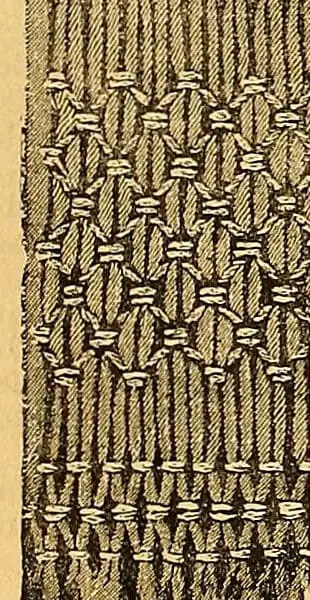
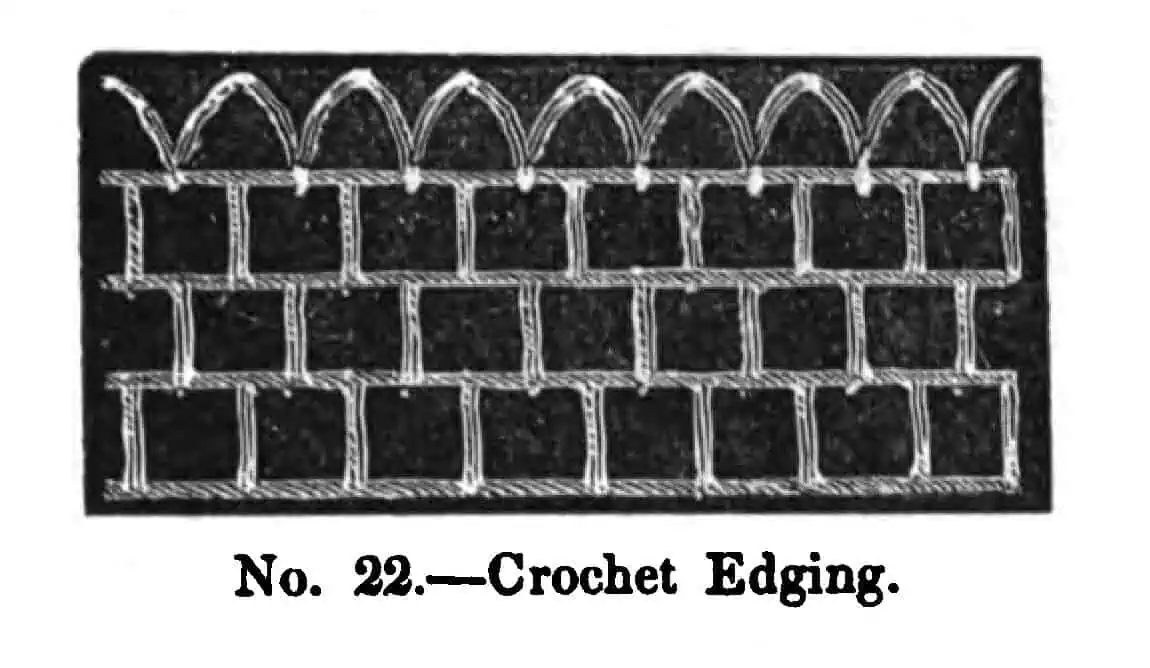
Open crochet — Make a chain or foundation as before. Commence with 1 plain stitch, bring the silk round the crochet, and pass it through the next loop of the chain, bringing the silk through. This will produce 3 stitches on the needle; draw the silk through the 2 first, which will leave 2; draw the silk again through these two, this will produce a long firm stitch; make a chain stitch, miss one of the foundation stitches, repeat the stitch just described alternately with the chain stitch.
Double open crochet is formed by repeating this stitch twice, making 2 plain chain stitches, and missing 2 of the foundation. Treble open crochet is done in the same way, by making 3 long stitches in 3 successive loops, and missing 3 of the foundation, making 3 chain stitches over them. In the following rows, the 3 long stitches are made in the chain stitches, and the chain stitches over the 3 long stitches.
This forms a dice pattern, and beads look very pretty on it. In the centre stitch of each of the long stitches a bead introduced has a very good effect. A pretty variation in treble open crochet is made by putting the 3 long stitches in one, making 1 plain chain stitch, and missing 3 of the foundation or preceding row.
Of course, in continuing this pattern, the 3 long stitches must be made in the one single chain stitch, and the one chain stitch is made to come over the 3 long stitches.
Things to make with it
A mat — Commence on a chain of 6 stitches, make it round, by uniting the first to the last stitch; make 2 stitches in every stitch in the 1st round, 2 in every other stitch in the 2d round, 2 in every 3d stitch in the 3d round; this is done in the clouded wool: 3 rounds are then done in the plain colour, increasing 2 in 1 in every 3d stitch in the 4th round, 2 in 1 in every 4th stitch in the 5th, and 2 in 1 in every 5th stitch in the 6th.
The next 3 rounds are done in the clouded; The following rounds are done in plain wool: 2 in 1 in every 7th in the 10th round, ditto in every 8th in the 11th. Then take a larger crochet, and work 3 plain rounds, which is the foundation of the border. Then take the clouded wool, and begin exactly at the commencement of the 11th round; take up the loop stitch or part of the stitch that lays across, and work a stitch of single crochet, and a chain stitch after it, loosely, into each stitch for the 3 rounds.
A larger crochet than you have used for the other part should be used for this border, as it should sit up quite loosely, and form a fringe to the mat Halfan-ounce of 8-thread German wool, and 1 ounce of clouded wool of the same size, will make 3 mats.
A muff — This is done in 5 shades of 8-thread German wool, either shades of sable or grey. The stitch is as follows: — 1 row double crochet; then 2 stitches taking the upper part of the loop, and 2 taking the under part of the loop alternately. The stitches where you take the upper part of the loop must be the same throughout, and also those for the under, still working the stitch of double crochet.
Commence with the darkest shade, and work 2 rows of each to the lightest; then reverse the shade, going back to the darkest. This is the half of the muff, and, if you repeat the shades in the same order, will complete it The ends are drawn in a little; it is padded, lined with silk, and trimmed with cord and tassels, or a fringe.
A cap — In double crochet, 8-thread wool, and No. 6 knitting cotton. Commence with 7 stitches of black, make 2 stitches in 1 until you have 15 stitches. Take white cotton and scarlet wool, and make 1 stitch of each in each of the 15 stitches of black; work 3 additional rounds of 1 stitch of scarlet and 1 of white cotton, making in all 4 rows.
This forms the 1st row of points. Second point or square: — Work 2 stitches of black into each stitch of scarlet, and 2 stitches of scarlet into each stitch of white, making 2 and 2 of each all round; work 3 rows, making 1 stitch of scarlet in each stitch of scarlet, and 1 stitch of black in each stitch of black.
Don't lose this article. Enter your email below, and I'll send it to you right now. Plus a little crochet inspiration from me, straight to your inbox.
This completes the 2d square. Third square: — In the 1st stitch of scarlet make 2 stitches with white cotton, and in the 2d stitch 1 stitch with white cotton; this makes 3 stitches. In the 1st stitch of black make 2 stitches with scarlet, and in the 2d 1 stitch; continue this all round, which makes 3 and 3 of each.
Work 3 more rounds, keeping 3 and 3 of each. Fourth square: — In the 1st stitch of scarlet make 2 of black, and 1 stitch in each of the other 2 stitches; in the 1st stitch of white make 2 of scarlet, and I stitch of scarlet in each of the other stitches of white.
This makes 4 and 4. Work 3 more rounds in this way. Fifth square: — In the 1st stitch of black make 2 stitches of scarlet, and 1 stitch of scarlet in each of the other 3 stitches; in the 1st stitch of scarlet make 2 stitches of white cotton, and 1 stitch in each of the other stitches of scarlet.
This makes 5 and 5 all round. Work 3 more rounds in this way. Sixth square: — Make 2 stitches of black in the 1st stitch of scarlet, and 1 stitch in each of the other 4 stitches; make 2 stitches of scarlet in the 1st stitch of white, and 1 stitch in each of the other 4 stitches.
This makes 6 of each all round. Work 3 more rounds in this way. Seventh round: — Make 2 stitches of scarlet in the first stitch of black, and 1 stitch in each of the other 5 stitches; make 2 stitches of white in the 1st stitch of scarlet, and 1 stitch in each of the other 5 stitches.
This makes 7 stitches all round. Work 3 more rounds of this, which completes the 7th square and the crown. For the lower part round the head, make a chain of 150 stitches, work 2 Third row of squares: — Make 2 stitches in 1 in the 1st stitch of every square, making 6 stitches of each of scarlet and white, the white coming over the scarlet, and the scarlet over the black; 4 rows as before, to form the square.
Next round, without increasing: — Scarlet and black; bring the scarlet over the white, and the black over the scarlet. Work 4 rows. Next round: — Make 2 stitches in 1 in the 1st stitch of every square, making 7 and 7 stitches of scarlet and white, bringing the white over the scarlet, and the scarlet over the black.
Four rows as before. This makes the 5th square. Sixth square: — Make 2 in 1 of the 1st stitch of every square, making 7 and 7 of each in scarlet and black. This completes the squares. This part is joined to the crown by taking up the top-part stitch of each with 1 row of black. A black leather front is added, and head-lining of silk.
A cardinal — Commence with a chain of 112 stitches, do 1 plain row, turn back, and at the end of the 2d row leave 5 holes at the top, turn back, and go to the end of the row; in the next row leave 5 more holes at the other end; continue doing this, every alternate row, for 14 rows.
This forms 1 gore, 14 of which complete the cardinal. After each row is finished, carry the next to the top; the 2d gore on each side from the front, leave 36 stitches in the centre, and make a chain of 36 stitches, to correspond with it in the following rows. This forms the armholes: — A border is worked round the top and bottom, in colours, on white ground, and 2 rows in single open crochet, in scarlet, carried round the sides and collar at the top; also, 2 rows in single open crochet are worked round the armholes.
A bag in gold and violet — The centre stars to be of gold, with a rich bright violet for the outer part. After this, work 2 plain rows of black; take the pattern from the woodcut, No. 27. Work the side nearest the violet in bright green, and the other in ponceau, the centre part in white.
Repeat these 2 patterns alternately till the bag is large enough. About 3 skeins of the black, and 1 of each of the colours, will be sufficient. Crochet it up at the bottom by taking a loop from each side, and uniting it with a stitch of single crochet. When finished, cut a stiff pasteboard, and put the bag on it, slightly damping it first Let it remain on till perfectly dry, and make it up with suitable cords and tassels. Coarse silk should be used.
A bag in purse-silk — Make a chain of about 140 stitches: this should be done in extra-coarse purse-silk, and a steel crochet, as in plate No. 28. Take 1 skein each of scarlet, green, black, blue, lilac, and gold-colour, or gold twist. Work 2 rows of double open crochet with the gold, and 1 row of plain double crochet with the black.
Next row: — Begin the pattern, and work 1 row of it in bright scarlet on a black ground, then a row of plain black,, work 2 rows of double open crochet with the gold and 1 row of plain black, work another row of the pattern in bright blue on a black ground, then a plain row of black, work 2 rows of double open crochet in gold and 1 plain row of black, work another row of the pattern in violet colour on a black ground, work a plain row of black, 2 rows of double open crochet, another plain row of black, and work another pattern in French green on a black ground, work 1 plain row of black, and finish with 2 rows of double open crochet with the gold.
This bag should be made up with gold, or gold and coloured tassels, with cord and slides to match. Crochet it together at the bottom.
A beaded cord — beads, as taste may dictate; thread 6 rows of beads on a skein of silk; make a chain of 7 or 5 stitches, join them to form the round, work in single crochet 1 stitch, pass down a bead to the end of the silk, work another stitch, pass down another bead, work another stitch, and so on, passing a bead and working a single crochet stitch alternately, till the chain is long enough.
A baby’s cap — Make a chain with the claret wool of 84 stitches. (The whole is worked backwards and forwards, and in turning back you take the top loop of the row before.) Work 3 rows of claret. After these rows, decrease a stitch at the commencement of every row mentioned (that is, by taking the tops of 2 loops and working them as one).
Work 2 rows of shaded amber, 4 of claret, 2 of lilac, 4 of claret, 2 of amber, 4 of claret, 2 of lilac, 4 of claret Work 1 additional row of claret all along the row, working 2 stitches as 1; thus reducing the number to half of what you had in the preceding row.
Do 2 rows of the amber, decreasing 1 at the beginning of each. Then 1 row more of claret, working the “2 loops together all along; 1 plain row. This finishes and is the back of the cap. Work 1 row of double crochet with the claret all the way round, working 1 stitch for each row round the back; then with claret work a row in single open crochet at the sides round the ears; at the 2 stitches that form the point on each side, work 3 stitches in each; then 1 row of lilac, single open crochet; 1 of claret; 1 of amber; 1 of claret; 1 of lilac; and 1 of claret: then crochet it to the row of claret worked all round, which makes a double frill.
Make a cord and tassels of the wools, mixed, to tie it, and also put one at the back to draw it in.
Ridged crochet — This is done in treble open crochet and ridged crochet. Ridged crochet is a pretty variation on plain double crochet. Make a chain the length required, and work 1 row of plain double crochet the loop from the farthest side, and work it as in plain crochet. Continue in this manner, taking the farthest loop each time; this will produce a ridge: each row is worked in this manner, and always worked backwards and forwards.
A bag in four colours — Take 1 skein each of extra-coarse silk, or Paris cord, of black, ponceau, green, and violet. Commence with the black, make a chain the length required, and work 1 row ridged crochet. Fourth row: — Green; all in ridged crochet. Take the violet, and work 1 row of treble open crochet, 1 row with the ponceau, 1 row with black, 1 row with green; take the violet, and work 1 row ridged crochet, 1 row with the green, 1 row with black, 1 row with ponceau, 1 row with violet; take green, and work 1 row treble crochet, 1 row black, 1 row ponceau, 1 row of violet; take the green, and work 1 row ridged crochet, 1 of black, 1 row of ponceau, 1 row of black. This completes the bag. The open work of this looks well with gold thread laced in and out of it
A pattern in steel beads — Take the pattern shewn in the plate No. I, and work it in steel beads, on a rich French blue ground, in plain crochet, first threading the number of beads required for 1 row; then, with a bright ponceau colour, work 2 rows of double open crochet. Repeat the pattern in beads and the 2 rows of double open crochet, alternately, till 8 rows of the pattern are completed.
Source
Cornelia Mee, Crochet Explained and Illustrated (1845). Public domain. Internet Archive crochetexplaine00meegoog.
Reproduced verbatim from the scanned original. Obvious scan errors (broken letters, words split across a line) have been mechanically corrected; nothing has been rewritten or modernised. Numbered plates referred to in the patterns are the book’s own coloured charts, which are not reproduced here.