By Annie Brooks
Macramé is worked flat on a cushion, with the threads hung from pins and every row pinned down as it is knotted. Two patterns follow, the second copied from an eighteenth-century piece.
Don't lose this article. Enter your email below, and I'll send it to you right now. Plus a little crochet inspiration from me, straight to your inbox.
Stars, cords and open knotting
To work — Fasten a row of pins into the Cushion a quarter of an inch apart, cut a skein of thi’ead twice, and hang two doubled threads on to each of the pins. First row — work a Macramé Knot on each four threads, reversing the Knot at every other group of threads. Second row — lay down a double thread as a Cord, and cover it with two loops from each thread.
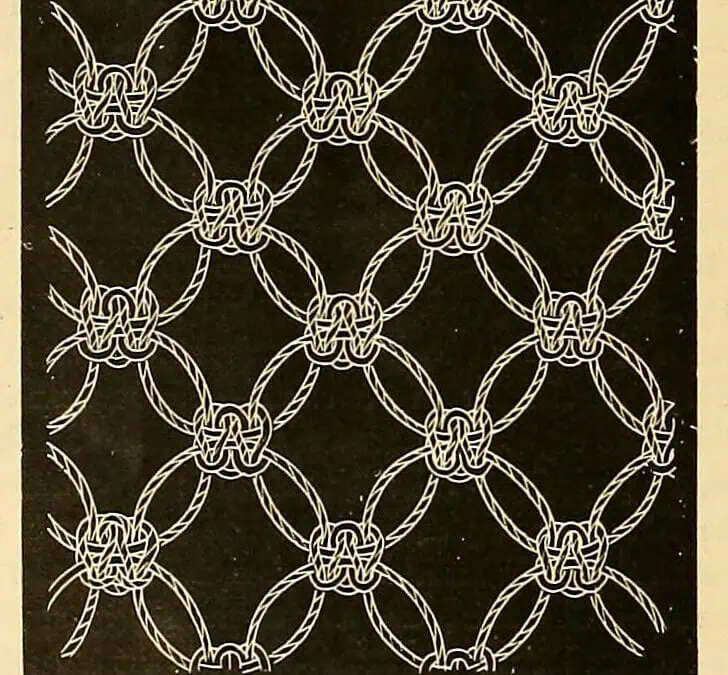
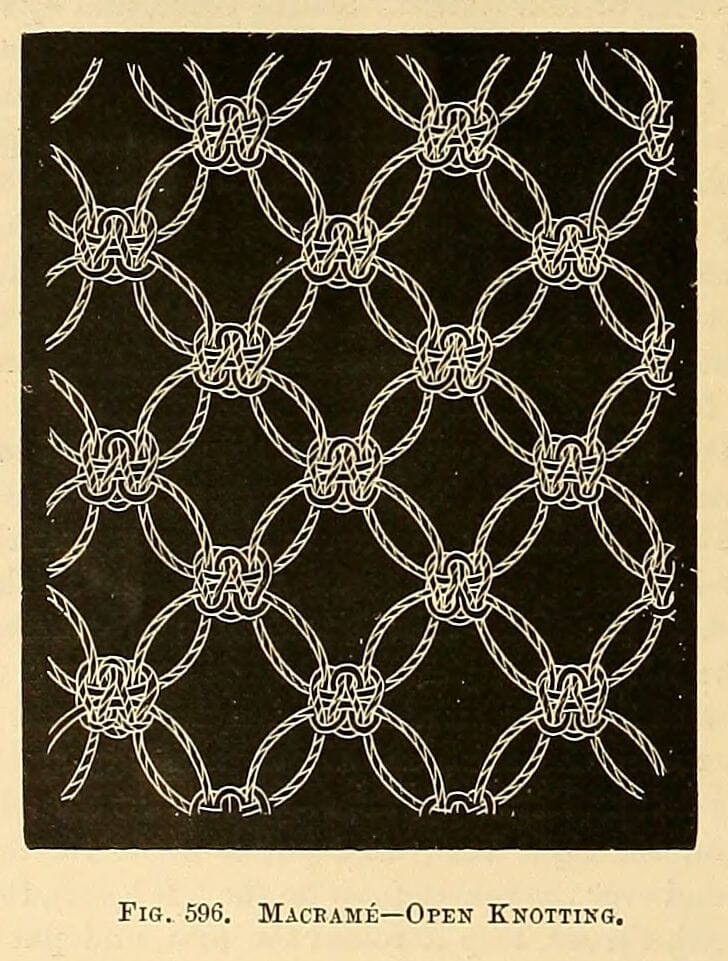
Third row — take the first twelve threads, and with the centre four work the Open Knotting with two knots, illustrated in Fig. 596; then divide the threads in half, and with the first six work the left hand top half of a Double Star, and with the last six work the right hand half of the same Star, but cross the second Leader of that half over the Leader of the first half, and keep it pinned down in that position ready for the next row; repeat to the end.
Fourth row — take the threads Nos. 11, 12, 13, and 14, and make the Open Knotting with two Knots, and pin down firmly; repeat to the end of the row, using the last two threads of one group of twelve threads and the first two of another for the Knot, then finish the lower half of the Star; on the Leader crossed over from right hand to left work all the left hand threads except thread No. 6, which make the first Leader on the right hand side, putting it under the crossed Leader; having completed the Star, work with the four centre threads of each group of twelve an Open Knotting Knot, as worked in the third row.
Fifth row — lay down a double thread and work a Cord. Sixth row — work an Open Knotting Knot with every four threads. Seventh row — work a Cord. Eighth row — take twenty threads and make an Open Knotting Knot with the middle four, then with the four on each side of the Knot work a short Cord slanting towards the Knot, pin all down, take No. 1 thread, make it a Leader, and work the left hand top side of a Treble Star, bringing in all the threads as far as No. 10; then, with No. 20 as first Leader, work the right hand top side of Treble Star, bringing in all the threads from No. 20 to No. 11; repeat to the end of the row.
Ninth row — work a Chain Bar with six Knots with every two threads. Tenth row — knot two Chain Bars together, redivide them, and work two Chain Bars with eight Knots each; repeat to the end of the row. Eleventh row — repeat the tenth row, but only work four Knots to the Chain Bars.
| Knot or bar | Rows it falls in | Count the pattern gives |
|---|---|---|
| Macramé Knot | First | One on each four threads, reversed at every other group |
| Cord | Second, fifth, seventh | A doubled thread laid down and covered with two loops from each thread |
| Open Knotting | Third, fourth, sixth, eighth | Two knots |
| Double Star | Third and fourth | Twelve threads, six to each half |
| Treble Star | Sixth, eighth, eighteenth | Twelve, twenty or eight threads |
| Chain Bar | Ninth, tenth, eleventh | Six knots, then eight, then four |
| Flat Solomon Bar | Second, third, fourth, seventh | Six knots, then four, then five |
| Twisted Solomon Bar | Fifth, sixth, eighth | Eight knots, then twelve |
An eighteenth-century pattern in Solomon bars
The following pattern — The following pattern, from a piece of Macramé Lace worked in the eighteenth century, can be worked from instructions without a design. It is formed with flat Solomon and Twisted Solomon Bars, and with Open Knotting, and is very easily worked, and extremely elegant. To work: Lay a double thread as a Heading, cut a skein of thread once, and loop on any number of threads that divide into four, and pin each down just enough apart to lie flat.
Don't lose this article. Enter your email below, and I'll send it to you right now. Plus a little crochet inspiration from me, straight to your inbox.
First row — lay down a doubled thread and work it as a Cord. Second row — make with every four threads flat Solomon Bars, six knots to each Bar. Third row — leave the first two threads, and with the four next make a Solomon Bar with four knots; repeat to the end of the row, always taking two threads from one Bar of the last row and two threads from the next Bar.
Fourth row — with the first four threads make a Solomon’s Bar with four knots, and repeat to the end of the row. Fifth row — leave the first two threads, and make with the next four threads a Twisted Solomon Bar of eight knots; repeat to the end of the row, always making the Twisted Bar with two threads from one Bar and two threads from another Bar of the preceding row.
Sixth row — commence with the first threads and make a Twisted Bar, as in the last row. Seventh row — leave the first two threads, and make Solomon Bars of five knots each. Eighth row — take the first threads and make Twisted Solomon Bars of twelve knots. Ninth row — leave the first two threads, and with the next four make the Single Open Knotting, illustrated in Fig. 595.
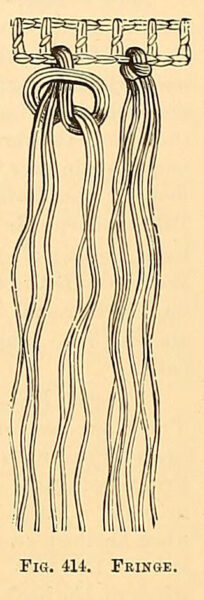
Tenth row — take the first two threads, and two from the first Knot, and with them work the Open Knotting, as in the ninth row. Eleventh row — work like the ninth. Twelfth row — Knot every four threads together and cut the ends of the threads straight, allowing two inches for fringe.
It is formed with flat Solomon and Twisted Solomon Bars, and with Open Knotting, and is very easily worked, and extremely elegant.
Source
S. F. A. Caulfeild and Blanche C. Saward, The Dictionary of Needlework. Public domain. Internet Archive dictionaryofneed002caul.
Reproduced verbatim from the scanned original. Obvious scan errors (broken letters, words split across a line, damaged fractions) have been mechanically corrected; nothing has been rewritten or modernised.