By Annie Brooks
The Dictionary of Needlework treats fringe twice over: first as goods sold by the piece in fixed widths and lengths, then as something a worker made herself. Both halves are printed here as they stand.
Don't lose this article. Enter your email below, and I'll send it to you right now. Plus a little crochet inspiration from me, straight to your inbox.
What the trade sold
Fringe — Fringe is a decorative bordering, consisting of loose or twisted threads, single or many, and composed of silk, cotton, wool, gold or silver twist, fastened on one side into a braid or heading, by which it is attached to dress or furniture. Those descriptions which are in general use for the latter vary from 2½ inches deep to 4 inches, and are of three kinds, viz., plain head, plain head and bullion, and gimp head ; those for dresses are called fancy fringes, and are made of silk or worsted, from \ inch to 2 inches or 3 inches in width.
Common fringes are classified by the trade as follows : Cotton bullion fringes, which are of a heavy make, in widths from 3 inches to 12 inches, and are chiefly used for bedroom furniture ; the lengths run to 24 yards or 36 yards. German fringe, of white cotton, made in various fancy patterns, their widths run from 1½ inches to 3 inches, and they are sold in lengths of 36 yards; they are used for blinds and bed furniture.
Toilet fringes are likewise of white cotton, their widths being from ⅜ inch to 2 inches, and are sold in pieces of 36 yards : they consist of various kinds — bullion, loop, star, plain, and open. Frange Grillee is another description (which see). Detached borders are added to most pieces of Fancy work when the main part is completed.
| Trade fringe | Widths | Sold in lengths of | Intended use |
|---|---|---|---|
| Cotton bullion | 3 to 12 inches | 24 or 36 yards | Bedroom furniture |
| German, of white cotton | 1½ to 3 inches | 36 yards | Blinds and bed furniture |
| Toilet, of white cotton | ⅜ inch to 2 inches | 36 yards | |
| Fancy, for dresses | ¼ inch to 2 or 3 inches | Dress trimming |
Fringe drawn from the cloth itself
Ancient fringes — Ancient fringes were formed by unravelling the material, and drawing away the threads one way of the stuff, and knotting the left threads into various patterns. These fringed ends to garments were the earliest description of knotted lace, and are frequently mentioned by old chroniclers, and as civilisation advanced, gold and coloured silk threads were introduced into the threads of the material, and these were most elaborately tied together and enriched with fancy stitches.
At the present time, the material, where it will allow of it, is still drawn away, and the threads that are left secured with a line of Buttonhole or Fancy Hem for a simple fringe, or Knotted as described below for an elaborate border. Where the material will not allow the threads to be drawn away, Ball Fringes, Tassel Fringes, and Knotted Fringes are made upon it as an edging, or Fringes are Crocheted, Knitted, or Netted and sewn round the work.
Knitting and Netting fringes are so rarely disconnected from their own work, that they are described under their own headings ; the other descriptions are used indifferently in Embroidery, Crochet, and Woolwork, and are as follows : — ■
These fringed ends to garments were the earliest description of knotted lace, and are frequently mentioned by old chroniclers.
Fringes worked by hand
Ball Fringe — Take a skein of single Berlin wool or filoselle, double it, and cut it in half, fasten it with a knot to one end of a long thread of gold cord, purse silk, or coloured wool, which bring it down three-quarters of an inch along the skein, loop it over the skein, and knot it into the loop, then carry the thread down three-quarters of an inch, and loop it again over the skein and knot the loop; make these loops at even distances apart until the skein is used up.
Take a sharp pair of scissors and cut the wool between the loops, cutting all the skein of wool, and only leaving the looped single thread; fluff these cut pieces over the loop into little round balls. Sew the fringe to the material, allowing it to hang down to the length of three or four balls.
Don't lose this article. Enter your email below, and I'll send it to you right now. Plus a little crochet inspiration from me, straight to your inbox.
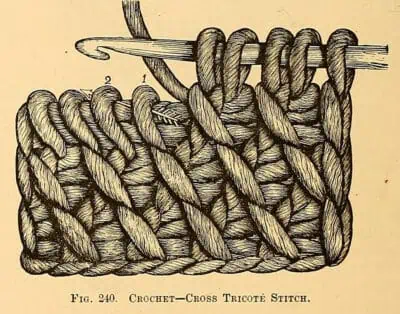
Crochet Fringe — This is made with two large bone Tricot needles, and with coarse wool. Make a six or twelve Foundation Chain, according to the depth of Fringe required. First row — put the wool round the hook to make a stitch, and then work the next two stitches, when finished, cross the last worked stitch over the first, and let the first down, retaining only the last worked stitch on the hook, wool round the hook, work the two next stitches, cross them over each other, and drop one as before, and so on until the row is finished.
Second row — turn the work, hold it in the left hand, and pick up the second hook. Work back with the second hook, making the same stitches, but using the made stitch of last row as one of the crossed stitches of this row, Third row like the first, using the first hook to work with.
Fourth row like the second row, using the second hook, work until the proper length of fringe is made, then unravel half the stitches to form a series of loops at one side.
Fringe Made Over a Mesh — Take a large wide mesh or a strip of wood according to the size required, and single Berlin wool or Crochet cotton. With a crochet hook make a Chain, then pass the wool round the mesh and draw it through the loop of the Chain on the hook, pass it again round the mesh and draw it through the Chain on the hook, make 1 Chain and pass the hook through the first Chain made.
Repeat the stitch from the commencement. The single Chains are necessary to prevent the long loops formed on the mesh becoming irregular when the mesh is withdrawn. A variety of this fringe is made by having the loops twice the length, and knotting them together as in Knotted fringe.
Knotted Fringe — Fix along the edge of material at even distances apart, four to six doubled strands of filoselle or purse silk. Make a hole in the material with a stiletto, and knot them into this hole or knot them on as in the last Fringe. Fasten the material to a lead cushion and take half the threads from one knot and half from the next, and with a needle threaded with the same silk fasten them together as a knot with Overcast Stitch, run the needle up and down the threads to the place where the next knot is to be formed and repeat.
The knots can be tied instead of Overcast. In the second row of Knots, knot the threads together that are together at the edge of the material ; for the third row, repeat first row.
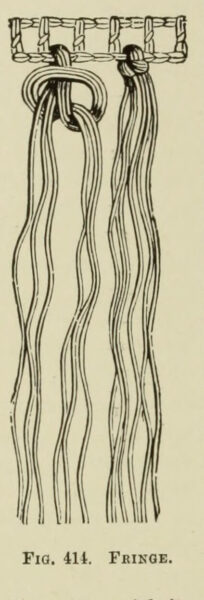
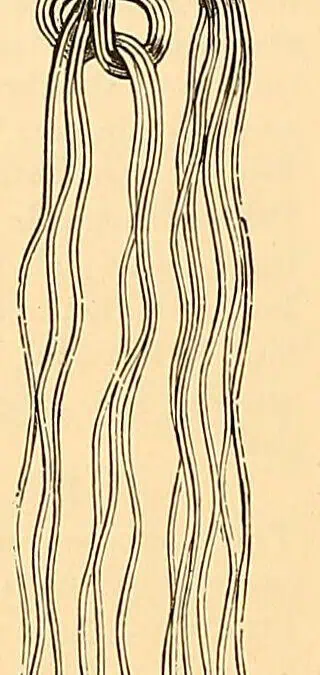
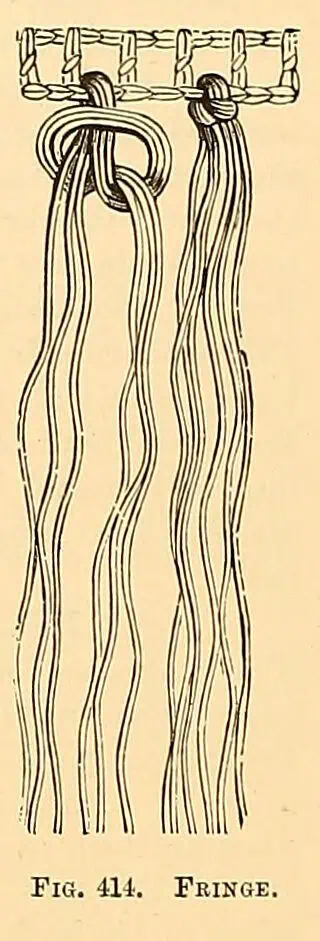
Knotted Fringe, like Fig. 414 — Wind over a thin flat book or piece of wood a good quantity of wool or thread, cut it at one place, and lay it straight. Pick up three threads, place them evenly together and fold them in half. Push a crochet hook through the foundation material and take up the bent end of the threads and draw them through the material for a short distance, then put the crochet hook round the end of the threads and draw them all bodily through the loop and well tighten the knot thus made. Continue to fasten these strands of thread into the material until a thick fringe is made.
Source
S. F. A. Caulfeild and Blanche C. Saward, The Dictionary of Needlework. Public domain. Internet Archive dictionaryofneed001caul.
Reproduced verbatim from the scanned original. Obvious scan errors (broken letters, split words, damaged fractions) have been mechanically corrected; nothing has been rewritten or modernised.