By Annie Brooks
Tape work and tatting sit a few entries apart in the Dictionary, and are made to work together — tape rosettes joined by tatted circles. Between them the alphabet drops in tarlatan, tartan and a tassel.
Don't lose this article. Enter your email below, and I'll send it to you right now. Plus a little crochet inspiration from me, straight to your inbox.
Rosettes folded out of tape
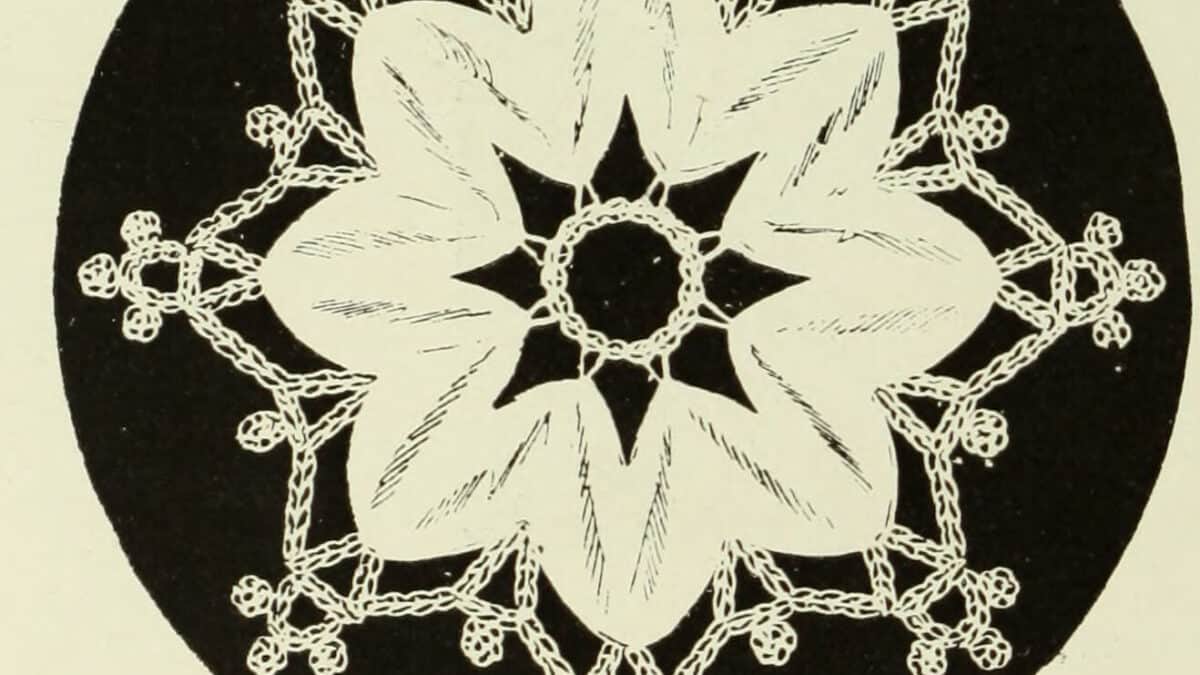
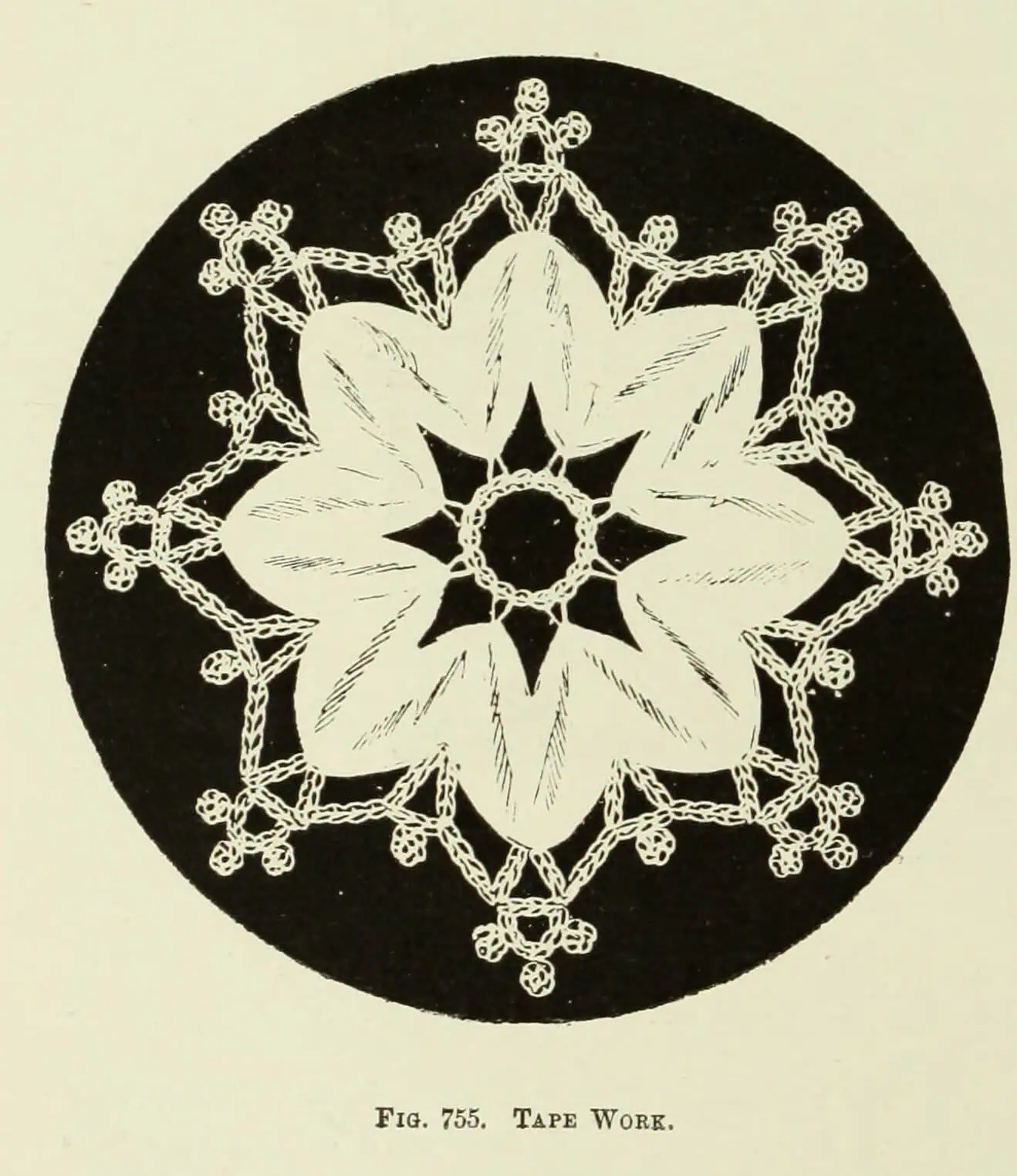
Tape Work — A modern work, and one that is generally combined with Crochet or Tatting. It consists of forming rosettes with broad or binding tape, and uniting these rosettes with Crochet or Tatting as antimacassars, mats, or other drawing-room ornaments. The materials required are soft untwilled Tape, known as Chinese or Binding
To work the rosette — Take a piece of Chinese Tape 1 inch in width; cut it to a length of 13 inches, fold it in half-quarters, eighths, and sixteenths, so that sixteen lines are formed down its width. Crease these well to render them visible; sew the two ends together neatly with Running and Felling, and take a thread and run it in as a Vandyke line, from the bottom to the top of the tape, so that each point is upon one of the sixteen lines.
Draw the tape together by means of this line, but not quite close, and fasten off the thread securely. Take a Crochet hook and Arden’s Crochet cotton (No. 16), and finish off the rosette with Crochet. For the outside, pull out the points, and commence to work at the bottom of one of them. Make 4 Chain, f, a Picot (made with 5 Chain drawn together by putting the hook back into the first made of the five), 1 Chain, 1 Treble, into the place where, the Crochet commenced, 3 Chain, 1 Treble into the top part of the point, *, 1 Chain, a Picot, 1 Chain; repeat from * twice; 1 Treble into the top of the Treble first worked on the point to make the crossbar; 1 Treble into the point side by side with the first Treble, 3 Chain, 1 Treble into the hollow or lower part of the point, 1 Chain, and repeat from f until the circle is complete; then fasten the first 3 Chain to the last, and tie and cut off the cotton.
For the centre: Work 1 Double Crochet and 1 Chain between every centre point, catching the Double Crochet into the top of the point.
To make an antimacassar — Work thirty-six of these rosettes and join them by the following small Crochet rosette: Make a Chain of 10 stitches, which join up, and work 16 Double Crochet into it. Second round — 1 Chain and 1 Treble into every second stitch on the first round. Third round— 1 Treble *, 1 Chain, 1 Picot; repeat twice from *, 1 Treble into the same stitch as the first Treble, 6 Chain; repeat from the commencement, and work this over every Treble in the second round.
Rosettes all of tape — Rosettes can be made entirely of tape. They are cut and sewn up, and run with a Vandyke line as previously described, but are drawn together quite in the centre. Unite them by sewing together at the points, and use the following small Tatted Circle to fill in spaces left between the uniting points.
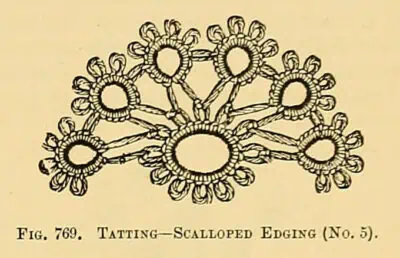
The tatted circle — Make a loop, work 4 Double, 1 Purl, *, 1 Double, 1 Purl; repeat from * four times, 5 Double; draw the loop up as an oval and work a second, but in this omit the first Purl and join the work to the last Purl on the first row instead; repeat until eight ovals are made.
The number of ovals will depend upon the size of the cotton used and can be varied. Join the Rosettes to the Tatted Circles at their Purls.
Vandyke braid insertion — Another Description of Tape Work is made by simply joining Vandyke braid to form insertions,. To work: Take Vandyke braid of a narrow width, and sew three of the points close together upon one side of it, and sew together the next three points upon the opposite side. Continue to sew these points together alternately at each side until the length of the insertion is obtained.
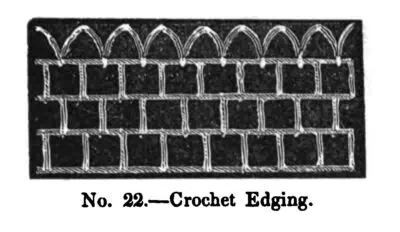
Make three lengths of tape in this way, and then join them. For the edge, work in Crochet 3 Chain, 1 Single, join to the point nearest to the one commenced at; then 4 Chain over the hollow, 1 Single, join to the points; repeat from the commencement, and work both sides alike. This last kind of Tape Work, when executed with narrow braid instead of tape, is known as Mignardise Crochet, and is described under that heading in Crochet.
Tape Lace Work — In this work the solid parts are made with narrow tape, drawn up into scallops or points, as previously described, and the open parts with Lace Stitches. To work: Take fine braid, a quarter of an inch in width, either white or coloured; cut off 12 inches, which sew up and run as described before, and make twelve points upon both sides.
Draw these only slightly together, and sufficient to form an open rosette. Take Lace cotton, and fill in the centre of this rosette with a series of rounds in Point de Bruxelles. Connect each Point de Bruxelles in the first row to a point of the rosette; work into the loops of the first row for the second; and work three to four rows, gradually lessening the size of the loops, so as to draw to a centre.
Enclose this rosette with straight lines of tape. Make these by Running the Vandyke lines upon the tape as before, and drawing them up, but leave as long straight lines. Sew these to the rosettes at the top and bottom, and the rosettes together in the centre of the work; fill in all spaces left between the tapes with English Wheels and Ornamental Bars.
| Step | As the entry gives it |
|---|---|
| Tape | Soft untwilled Chinese or binding tape, 1 inch wide |
| Length cut | 13 inches |
| Folds | Half-quarters, eighths and sixteenths — sixteen lines down its width |
| Joining the ends | Sewn neatly with running and felling |
| Drawing it up | A thread run in as a Vandyke line, each point on one of the sixteen lines |
| Finishing | Crochet worked in Arden’s Crochet cotton, No. 16 |
| For an antimacassar | Thirty-six rosettes, joined by a small crochet rosette |
| The tatted circle instead | Eight ovals, the number varied with the size of the cotton |
Where the alphabet interrupts
Tapisserie — The French term for Tapestry, and for any description of hangings, the word Tapis denoting a carpet. See Tapestry.
Tapisserie d’Auxerre — This Embroidery consists of working with Berlin single wool, in Satin Stitches, upon net. It is used to form antimacassars, or to stretch upon a frame in front of fire grates. The designs are chiefly of stars, circles, diamonds, and other geometrical figures. To work: Select a rather open and stiff hexagonal net, either of black or white; divide this off’ into squares before commencing the work, so that the designs may be evenly embroidered.
Take a black or white thread, so as to contrast with the net, and run it into one row of the net. Miss thirty meshes, and run in another line, and repeat until the net is marked out with horizontal lines of thread, then run lines across the horizontal ones to form perfect squares upon the net.
Mark out upon paper the outline of the diamond or cross to be worked, and see that it fits into one or several squares, hold this under the net, and make Satin Stitches upon the net with single Berlin wool, to fill in the figure, move the paper pattern, and work in the design until all the squares are full, varying the colours of the wool. Finish off by drawing out the threads from the net that made the squares.
Tarlatan — A thin, gauze-like muslin, much stiffened, and so called from the chief centre of the manufacture, Tarare, in France. It may be had in various colours, and is much used for evening dresses. It was originally an Indian manufacture, which was copied in Europe. The width of Tarlatan is very considerable, measuring from 1½ yards to 2 yards in width.
Tartan — A term denoting the chequered pattern peculiar to the Scotch national costume, the varieties in the colours, combinations of the same, and the dimensions of the squares in each pattern, distinguishing one Clan from another. There are also Fancy Tartans, which, together with those of Scotch origin, are produced in silk and stuff dress materials, woollen shawls, handkerchiefs, ribbons, stockings, and socks.
Tartan woollen stuffs were introduced from Normandy in the eleventh century, and are commonly called Plaids, the material and the chequered patterns and combinations of colours being usually confounded together under the name Plaid. Before the sixteenth century there is no record of the Tartan being the distinctive costume of the Scottish Clans, as it was common to many nations besides.
Their Brechan, or Plaid, consists of 12 or 13 yards of narrow chequered woollen cloth, wrapped round the body, brought over one or both shoulders, and crossed at the back, the ends hanging to the knees. Its use in Scotland, as such, was prohibited by Act of Parliament in 1747, and the Grey Shepherds’ Mauds were manufactured instead; the Act was repealed in 1782. See Fancy Checks and Plaids.
Don't lose this article. Enter your email below, and I'll send it to you right now. Plus a little crochet inspiration from me, straight to your inbox.
Tassel — Tassels are used as a finish to embroidered cushions. To make: Take some of the silks or wools used in the embroidery, selecting the greatest number from the shade chiefly used in the work. Wind these round a piece of cardboard, 3 or 4 inches wide, and, when enough has been wound to make a thick Tassel, push the whole off the card.
Thread a wool needle with some silk, twist this round the wound wool, half an inch from the top, secure it with a stitch, push the needle up through the top of the Tassel, and fasten the Tassel on to the material with it, and then cut the ends of wool apart that are at the bottom.
There are also Tassels which are machine-made, pendent tufts of silk, wool, cotton, thread, or gold and silver cord, sometimes attached to the end of cords, or to a gimp or braid heading, following one another in a row. They are sold separately, or as a trimming, by the yard; they may be had in every colour and combination of colours, to suit any article of dress or upholstery, and are made in Chenille, fine silk thread, and silk twist.
The worsted sorts are chiefly used for furniture decorations, but are also manufactured in fine qualities for dress. Blind Tassels are made of unbleached thread, as well as of worsted in white, scarlet, green, and other colours.
Tatting, and what the second shuttle changed
Tatting — The precise date of the first introduction of Tatting cannot be determined, as, for many years, it did not take any prominent position in the arts of the day, but it has been practised for more than a hundred years, and is a reproduction of the Ragusa Gimp Laces and Knotted Laces of the sixteenth century, of which Knot Work was the first imitation.
Knot Work is made over a cord, with the cotton forming it wound upon a netting needle, but in Tatting the stitches are made over a thread, and the thread wound upon a Shuttle small enough to allow of its being passed easily backwards and forwards over and under the thread it is forming the stitches upon.
The English name of Tatting, taken from the word Tatters, indicates the fragile piece-meal nature of the work, as does the French name of Frivolité; but however fragile and lace-like in appearance, it is exceedingly strong, and capable of bearing much rough usage. Unlike Crochet and Knitting, where each stitch is slightly dependent on its neighbour, and one becoming unfastened endangers the rest, the stitches of Tatting are isolated as far as their strength goes, being composed of knots and remaining separate knots, and are very difficult to undo when once formed.
The work consists of so few stitches that it is extremely simple, and requires neither thought nor fixed attention when once the nature of the stitch has been mastered, a glance, or the feel of it passing through the fingers, being sufficient for an experienced Tatter. It also has the advantage of being very portable, and can be worked at for a few minutes and put down again without becoming disarranged, which is an impossibility with many descriptions of lace.
Before the picot — For many years Tatting was made as a succession of Knots over a loop of its own thread, which was then drawn up and the stitches on it formed into an oval by being drawn together. These ovals had the appearance of Buttonholes, and were only connected by the little piece of plain thread that was missed after one oval was made and before the next loop was formed.
To connect them at all tightly a needle and thread were used, and they were sewn together at their widest part. Two great improvements to Tatting have been made within the last fifteen years; first, the introduction of the lace loops known as Picots, and called Purls in Tatting, which trim the edges of real lace and add much to its lightness; and secondly, the use of a second thread or Shuttle, which enables straight lines and scallops to be worked, as well as the original ovals.
The Purls worked round the edge of the ovals and straight lines serve to soften their thick look, and they also are used to connect the various parts, the thread being drawn through a Purl and secured with a knot (where a join is to be made), while the lace is in progress, instead of having recourse to a needle and thread.
The second thread or Shuttle enables the Tatter to execute elaborate designs that were quite impossible when only one thread was used. The two threads are tied together, and the first is used to form a loop and make an oval, while on the second the first thread forms the stitches, and leaves them upon it without drawing it up; it is then in a position to make a loop and work an oval if required, and to continue forming stitches upon the second thread whenever the pattern so directs, thus making the work twice as ornamental, and enabling large and wide designs to be formed.
The two double-thread methods — There are two ways of working with the double threads, the one most used is made by winding the first thread upon the Shuttle and securing it to that, while the second thread is either left attached to the skein or wound upon the second Shuttle and remains passive, all the stitches being formed upon it with the first thread, which forms loops of itself, and covers them, to make ovals where required.
In the second plan, invented by Mrs. Mee, the working thread is not detached from the skein, and so joins in it are obviated — and these must be frequent when it is wound upon a small Shuttle and detached from the skein. In this second plan, the second thread attached to the skein is placed above the one wound upon the Shuttle, when both are held in the left hand, and is put round the fingers of that hand to form a loop upon which the knots are formed by the Shuttle thread.
As the knots are really made from the loop, the waste all comes from that thread. When an oval has to be made, as the loop will not draw up, a crochet needle is used to draw the foundation thread up as a loop close to the last piece of completed lace, and the Shuttle being put through this loop, as in an ordinary join, forms the stitches into an oval.
The stitch — The Stitch or Knot of Tatting is formed with two movements— sometimes only one of these movements is made — and the stitch so made is known as Half Stitch, but the Whole or Double Stitch is the one almost universally used. It is very simple, but depends upon the position of the hands.
Hold the shuttle horizontally in the right hand, between the first finger and thumb, and rather backwards, and let the thread fall from it from the inner part of the right side; pass the other end ofthe thread, after making the loop (when only one thread is used) over the left hand. Slip the Shuttle under the loop thread, which let pass between it and the first finger of the right hand and back between it and the thumb, and bring it quickly out between the first and second fingers of the left hand.
Drop the loop from the last fingers of the left hand, but retain that finger and thumb upon it, give a slight jerk, so as to make the twist just formed transfer itself from the Shuttle thread to the loop, which it should be a part of; put back the left fingers into the loop and stretch it out, and draw the knot up close to the thumb while the Shuttle thread is tightened with the right hand.
Bring the Shuttle back over the left hand with its thread hanging downwards, and pass the loop under the Shuttle between the thumb and Shuttle, and back between the first finger and Shuttle, drop the loop, jerk, and draw up as before; when enough stitches have been formed, draw the loop up so that they form an oval.
The English name of Tatting, taken from the word Tatters, indicates the fragile piece-meal nature of the work, as does the French name of Frivolité; but however fragile and lace-like in appearance, it is exceedingly strong.
Source
S. F. A. Caulfeild and Blanche C. Saward, The Dictionary of Needlework. Public domain. Internet Archive dictionaryofnee05caul.
Reproduced verbatim from the scanned original. Obvious scan errors (broken letters, words split across a line) have been mechanically corrected; nothing has been rewritten or modernised.