By Clara June
The opening pages of a Victorian needlework guide. It sets out what crochet was used to make, which material suited which article, and then defines the elementary stitches in plain words.
Don't lose this article. Enter your email below, and I'll send it to you right now. Plus a little crochet inspiration from me, straight to your inbox.
What crochet was for
Shawls, sleeves, comforters, mittens, gloves, etc., may be made, without difficulty, in crochet. It has not, however, been deemed necessary in the following pages to give directions for any of these simple articles, as, when the crochet stitch is acquired, the modes of working such, and a variety of others, in daily use, will readily present themselves.
As an example of the double appropriation, which almost all the following directions admit of, we may instance the bottom of a bag; this, if commenced with a chain of about fifty stitches (not joining the ends), and worked in coarse wool, with a large needle, in rows backwards and forwards, gradually increasing with a seam stitch, will form a warm and comfortable round cape.
A paper pattern, the size of any desired object, can easily be cut — and the making a stitch at the commencement, or the decreasing in the middle, or the end of a row, and vice versa, render this work subservient to almost any form. thread size, with an ivory needle, offers the easiest kind of work with which we are acquainted.
It may be readily learned, and lia^, therefore, been much prac- tised, both by invalids, and by persons whose sight either needs relief, or has become impaired. All striped patterns, if desired, may be worked in narrow breadths, and joined in the dividing lines; so that a table cover may be made in four or six lengths, and afterwards sewn together with wool, without the least detriment to its appearance.
Crochet may be executed with coarse and fine chenille, for pillows, bags, caps, and waistcoats ; with crochet silk, for caps, slippers, and bags ; with coarse netting silk, it forms strong purses, bags, and slippers ; and the most delicate work may be done with the finer silks. Gold and silver cord, and passing, may be intermixed with the chenilles and silks, or employed separately ; and gold and steel beads, first strung on the silk, may be worked in various patterns, so as to produce the most rich and beautiful effect.
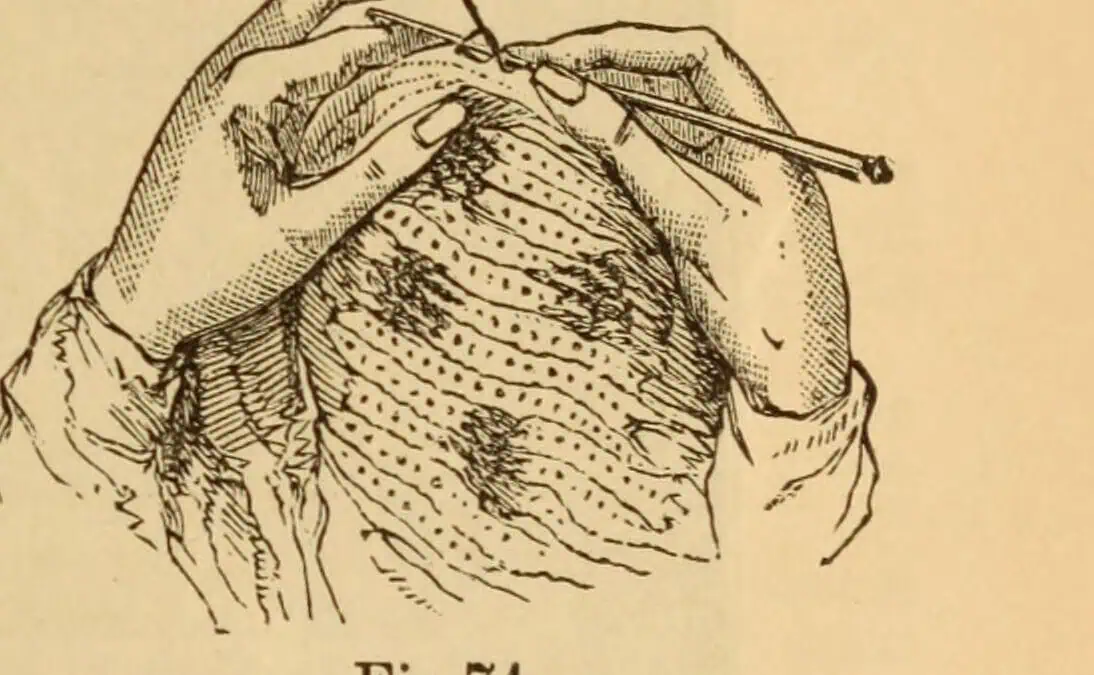
Crochet may be divided into plain single crochet, plain double crochet, plain stitch open crochet, and open crochet with one, two, three, or more stitches. These varieties will be described, as they occur, in the following directions for working. The mode of working the crochet stitch, although in itself most simple, is diffi- cult to describe in writing; but, which shows the position of the hands, and the manner in which the needle and the work should be held, we will endeavor to explain the elementary process.
Having wound a skein of wool, make a loop at one end ; through this loop draw another loop, through this second loop another, and so on, moderately tightening each, as it is drawn through, until a chain of sufficient length be made to serve as the foundation for the article intended to be worked.
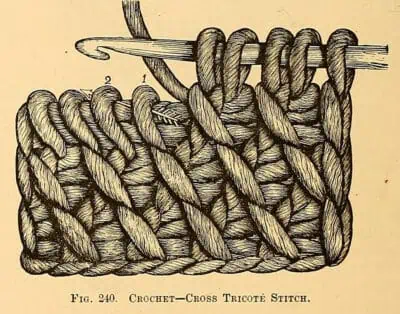
Pass the needle through the last loop of this foundation, and catching the wool, draw it through, repeat- ing the same at every successive loop; then, return along this row, and, in a similar manner, form a second. A repetition of this process, alternately backwards and forwards, from right to left, and from left to right, will give the first and easiest lessons. The work will be the same on both sides, producing by turns one raised and one sunken row.
Shawls, sleeves, comforters, mittens, gloves, etc., may be made, without difficulty, in crochet.
Don't lose this article. Enter your email below, and I'll send it to you right now. Plus a little crochet inspiration from me, straight to your inbox.
| Material | What it was worked into |
|---|---|
| Coarse and fine chenille | pillows, bags, caps, waistcoats |
| Crochet silk | caps, slippers, bags |
| Coarse netting silk | strong purses, bags, slippers |
| The finer silks | the most delicate work |
| Gold and silver cord, and passing | intermixed with chenille and silk, or used alone |
| Gold and steel beads | strung on the silk first, then worked into the pattern |
The elementary stitches
Chain-stitch — is the foundation of all other crochet. A loop is made on the hook, and through this the thread is drawn. A second loop being thus made, the thread is drawn through it; and so on, until the required number of chain-stitches is made. Observe that we never reckon the first loop in counting a chain.
Slip-stitch — A chain being made, the hook is inserted in the last stitch but one to that already on the needle, and the thread drawn through both together; then in the next stitch, and so on. In working back a chain in slip-stitch, you will always work one stitch less than the number of the chain, because the last of the chain is missed before the first slip is worked. This stitch adds
Double Crochet (Dc.) — The thread is passed once over the needle, before the hook is inserted in the chain through which the thread is drawn ; there will thus be three loops on the needle. Draw the thread through two, which leaves one and the new loop. Draw the thread through these j thus, by the double movement, completing the stitch.
Treble Crochet (Tc.) — is worked precisely like Dc; but the thread being put twice over the needle, instead of once, the stitch is completed by drawing the thread three times through two loops. When directions are given to work a stitch through another, you must put the hook under both threads of the last row.
To close a loop — , pass the needle through the stitch directed, and draw the thread through that and the loop already on the needle; as this takes up one stitch, one less than the number marked will be the actual size of every loop ; thus, a chain of sixteen for Open Leaf leaves fifteen to be worked round.
To fasten off — Cut off the thread about three inches from the work. Draw the end through the last stitch, and, with a common needle, run it up and down a few threads, invisibly, at the back. Do the same with the end left when the work was begun, and cut off close. The size of the crochet work depends entirely upon the style of working.
One person does crochet work in a very tight stitch, others very loosely, and a tew tjtitches had better be tried for every article before selecting the hook.
One person does crochet work in a very tight stitch, others very loosely, and a few stitches had better be tried for every article before selecting the hook.
Source
The Ladies’ Guide to Needle Work, Embroidery, etc. Public domain. Internet Archive ladiesguide00fros.
Reproduced verbatim from the original. Obvious scanning errors have been mechanically corrected; wording, spelling and punctuation are otherwise as printed.