By Annie Brooks
The Dictionary is unusually partisan in this entry. Crochet had lately taken netting’s place, on the grounds of portability, and the writer plainly expects the older craft to come back.
Don't lose this article. Enter your email below, and I'll send it to you right now. Plus a little crochet inspiration from me, straight to your inbox.
Netting before crochet
Netting in antiquity — Amasis, King of Egypt, presented a corselet to the Temple of Minerva, in the island of Rhodes, composed of the finest Netting, each thread containing 360 distinct threads, and yet the texture was so light and fine that the whole could easily pass through a man’s ring. A netted corselet, matching this one in delicacy, was given by the same monarch to Mutianus, the third Roman Consul, but this was embroidered with animals and figures worked with gold thread into the Netting.
In the writings of Pliny and Herodotus the fine flax used by the Egyptians is spoken of with admiration; and Homer, in the Iliad, mentions the Cauls and Networks of gold worn by the Trojan ladies. In the Bible there is frequent allusion to the art; some of the curtains adorning Solomon’s Temple were made of Checker Work or Netting; and Isaiah enumerates the Cauls of Network and veils worn by the Jewish women; and when summing up the calamities that were to fall upon Egypt includes in the general curse those who ” weave Networks.”
From the thirteenth century — We have little mention of Netting during the Roman Empire, and it is not until the thirteenth century that the art was practised in Europe so as to draw attention; it was then worked for ecclesiastical purposes and looked upon as lace. St. Paul’s Cathedral, in 1295, possessed a kneeling cushion of Network; and Exeter Cathedral, a few years later, several altar cloths.
In the thirteenth and fourteenth centuries Netting was known as Opus Filatorium and Opus Araneum, or Spider Work, the ground only was Netted, the design being Darned or Embroidered upon it; but the plain unembroidered Netting was frequently made either in silk or flax, and used as Curtains and Bed Hangings. At a later date Darned Netting was known as Lacis, and was worked more with flax than gold or silk threads, and in the sixteenth century this Lacis is frequently mentioned in wardrobe accounts, and finds a place in the articles enumerated in the will made by Mary Queen of Scots, before the birth of her son.
Lacis, when not Embroidered or Darned, was called Reseau or Rezeuil, and differed in no way from Plain Netting; nor do Lacis in any way differ from the modern Guipure d’Art, in which, upon a groundwork of Netting, a pattern is Darned and Embroidered. After the universal adoption of Pillow and fine Needle-made Laces, the Netted and Darned Lace was little used; but occasionally a specimen appears among the relics of palaces and old families, and a coverlet used by Louis XIV. is still in existence; it is made of a Netted Foundation with Darned Embroidery.
In England — In England, Netting has always been practised for useful purposes, and sixty years ago it was much worked for Curtains, Window-blinds, and Drawing-room Covers, either in Darned or Plain Netting. Crochet has lately superseded Netting, on account of its greater portability, but there is no doubt that the ancient art will again revive, and that its light and artistic productions are much superior to the work to which it has given place.
Each thread containing 360 distinct threads, and yet the texture was so light and fine that the whole could easily pass through a man’s ring.
| Date or period | What the entry records |
|---|---|
| Amasis, King of Egypt | A netted corselet given to the Temple of Minerva at Rhodes, each thread containing 360 distinct threads |
| Homer, Pliny, Herodotus | Cauls and networks of gold worn by the Trojan ladies; the fine flax of the Egyptians |
| The Bible | Checker work in the curtains of Solomon’s Temple; cauls of network worn by Jewish women |
| Thirteenth century | Worked in Europe for ecclesiastical purposes, and looked upon as lace |
| 1295 | A kneeling cushion of network at St Paul’s Cathedral |
| Thirteenth and fourteenth centuries | Known as Opus Filatorium and Opus Araneum, or Spider Work |
| Sixteenth century | Darned netting called Lacis; named in the will of Mary Queen of Scots |
| Louis XIV | A coverlet of netted foundation with darned embroidery, still in existence |
| Sixty years ago | Much worked in England for curtains, window-blinds and drawing-room covers |
| Lately | Superseded by crochet, on account of its greater portability |
Why every knot has to be tight
The strength of the knot — Netting is very easy to do, and it likewise possesses the advantage of being extremely strong, each loop that is made being independent, and if properly knotted remaining firm, whatever accident happens either to the ones before or behind it; for the same reason nothing is more difficult than to undo a piece of Netting when once made, every loop requiring to be separately unpicked and undone with a sharp pointed knitting needle or stiletto.
Good materials — The beauty of Netting consists in the regular size of the loops made, and the tightness of each individual knot, and this result cannot be obtained unless good materials are used and the art has been well practised. Bad thread and silk are liable to break when under the strain of being pulled into a knot, and a break in the material necessitates the thread being joined in the working of a row, which is to be avoided, not only for the knot so produced always showing, but also by reason of the loop that contains it rarely being made the same size as the ones surrounding it.
All joins in the working thread should be made at the first loop in a row, and with a Weaver’s Knot, and the netting needle should be filled, the worker keeping this fact in view.
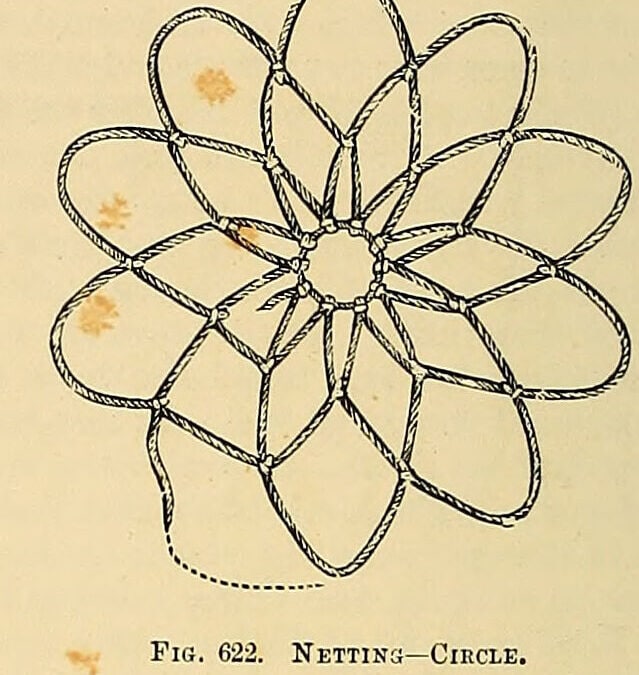
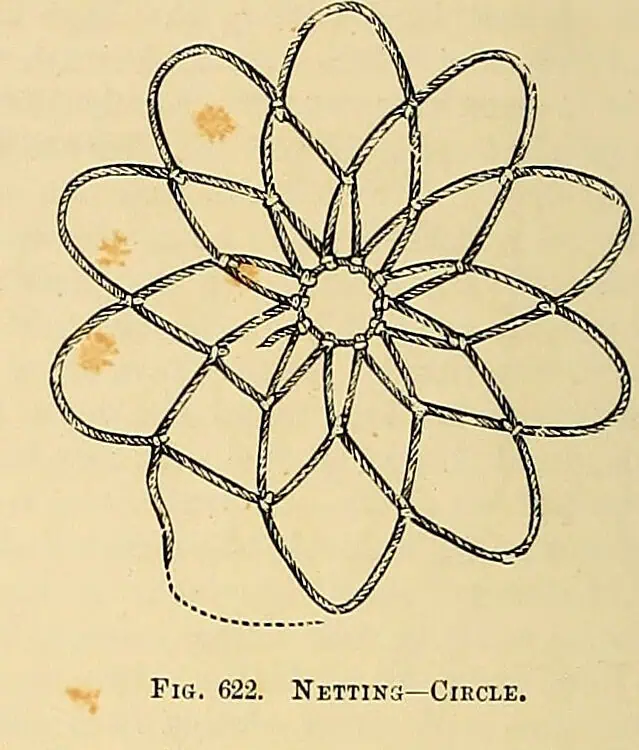
Loops and meshes — Every loop or knot in Netting counts as a stitch in other work; but it takes four knots to make what is called a complete loop or mesh in Netting. These meshes are generally of a diamond shape, and are made with Plain Netting; but Round and Square Meshes are also worked, in order to give a certain vaiiety and relief to the ordinary loop, which, however, is not capable of very much alteration; and varieties in Netting are more often made by working several loops into a loop, or by missing loops and crossing one over the other, than by changing the form of the loop worked.
Don't lose this article. Enter your email below, and I'll send it to you right now. Plus a little crochet inspiration from me, straight to your inbox.
Which way it hangs — Netting is always made the contrary way to what it will hang when in use, and in some articles, such as curtains and purses, the loops forming the length are all put on the Foundation Loop at once; while in others, such as lawn tennis nets, one loop is only put upon the Foundation Loop, and the right length made by Increasing in every row.
When the article is finished it should be slightly damped, and then well stretched, and pinned out upon a board, so that every mesh may assume its right position.
The implements, and the working of it
The implements — The implements used in Netting are few; they consist of a Netting Needle, which is a long piece of ivory, wood, numbered as to sizes in the same way as the needles; Twine, fine Knitting Cotton, or Silk, for making the Netting; and a Stirrup or Lead Cushion to which to attach the Netting while working, so as to resist the pressure each Knot in making throws upon the work.
The manner of netting — The manner of Netting is as follows: Wind upon the Mesh sufficient cotton for one row of Netting, but be careful that it will pass easily through the loops as they are made; then attach it to the Foundation Loop on the Stirrup and place the latter round the left foot, so regulated as to length that the row to be Netted is about on a level with the waist of the worker.
Take the Mesh in the left hand and place the thumb over it, and the fingers underneath it, hold the needle in the right hand with about twice its length in cotton between it and the work; put the cotton over the Mesh round the first two fingers and back on to the Mesh, so that it is held down with the left thumb; then pass the thread round above the work from left to right, and round the left hand, with the little finger of that hand holding it.
Push the needle through the first loop where it is underneath the Mesh and into the Loop on the row to be secured; take the right hand from off the needle where it is under the Mesh, and put it on the needle, so that it can pull it through, and draw the thread with the Loop to be secured on it and up to the Mesh.
Now gradually drop the turns of thread that are upon the left hand, let the one held down by the thumb off first, then the one between the forefingers, which absorb into the loop round the little finger, by stretching out that finger, and finally let that Loop off the little finger, pulling all the time with the thread still firmly held in the right hand.
The knot that is made with these movements should be close to the mesh, and so firm and strong as not to reply to any attempts to alter its position. Form each row of Netting with a succession of these knots, and work them always from the left to the right. When the end of a row is reached turn the Netting over, and commence to make the next row by working on the Loop last made.
Cushion — When the Stirrup is not used to keep the Netting taut, it is necessary to pin the work to a Cushion It is a large Cushion heavily weighted with lead and covered with cloth, and made so as to resist without yielding when each loop is pulled and knotted in the progress of the work.
Source
S. F. A. Caulfeild and Blanche C. Saward, The Dictionary of Needlework. Public domain. Internet Archive dictionaryofneed002caul.
Reproduced verbatim from the scanned original. Obvious scan errors (broken letters, words split across a line) have been mechanically corrected; nothing has been rewritten or modernised.