By Annie Brooks
Advanced pillow-lace directions, printed here as a document rather than a project. The whole point of the work is that it does not lie flat: petals are sewn up afterwards so the flowers open and close.
Don't lose this article. Enter your email below, and I'll send it to you right now. Plus a little crochet inspiration from me, straight to your inbox.
The first flower
The lace in relief has now to be worked. Begin with the first flower. This is worked flat upon the Pillow, the centre petals first. Work round the inner ring with five pairs, join the circle, add another pair and work up one side of petal, add three more pairs, then work Cloth Stitch, Sewing first to the stem and then to the inner circle, add by degrees four pairs, and Sew twice into each pinhole of the centre ring, to bring the Bobbins round; as each petal finishes, gradually cut off the Bobbins down to six pairs, then work the next petal.
These petals are not joined where they touch, but when the last is finished and the Bobbins are cut off to six pairs, the back petals in Half Stitch are worked over them. Each of these take sixteen pairs of Bobbins; add them gradually as the stem is worked. Work this stem one third of the way round; work over the part already done without minding it, take the pieces out, and leave it to be held down with the covering petal.
The difficult part of the work is in the Sewings, which are attached to the inner circle like the first made ones. To make these: Sew the small petals to the outer strands of the circle, and the large ones to the cross strands. Make three Sewings in the same place when doing the final leaves, and when these are finished put a Square Plaiting in the centre of the flower, and cut off the Bobbins.
Finish the flower by working leaf, stem, and seed pod in Half and Cloth Stitch and Open Braid. The flower opposite the one just worked is done in the same manner, the difference in the effect being produced when the lace is taken off the Pillow by the needle, one flower being made to fold up its petals, the other to open them out.
Crinkle Plaitings are worked in the centre of this last flower on the right side, after the lace is taken off the Pillow.
| Element | Bobbins hung on | Stitch |
|---|---|---|
| Centre petals of the first flower | five pairs, added by degrees to nine | Cloth Stitch |
| Back petals of the first flower | sixteen pairs each | Half Stitch |
| Centre flower, two inside tiers | not stated | Cloth Stitch |
| Centre flower, outside tier | not stated | Half Stitch, finished with Pearl |
| Seed pod, large oval | eight more pairs | Cloth Stitch |
| Seed pod, inside oval | six pairs, then seven more and a Gimp | Cloth Stitch |
| Butterfly body | seven pairs | — |
| Butterfly tracery and wings | five pairs | Half Stitch |
| Briony leaf | two pairs at the tip, then a cluster of five | Cloth Stitch, then Half Stitch back over it |
The centre flower and the seed pods
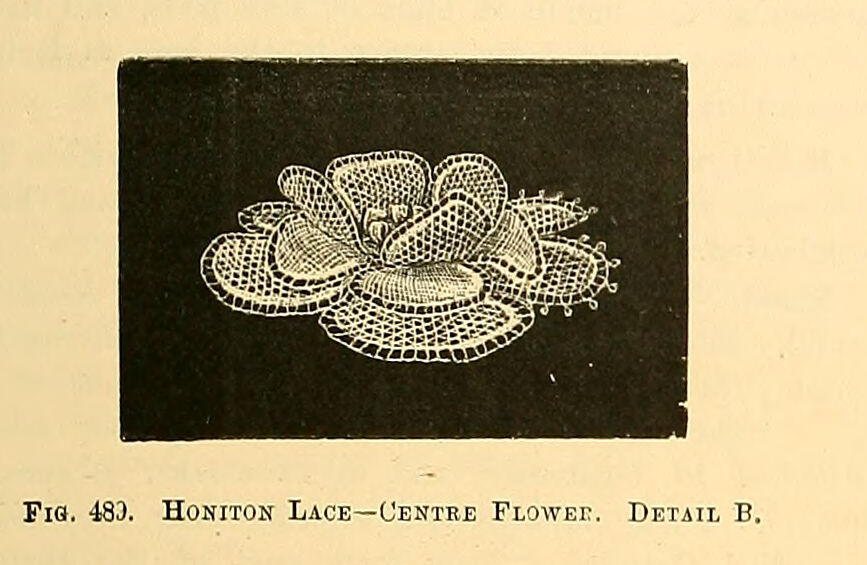
The centre flower, shown in Fig. 489, Detail B, is next made. It consists of three tiers of petals. Work the two inside tiers in Cloth Stitch, the outside tier in Half Stitch, and these last finish with Pearl where they form the edge of the scallop. Work these petals in the same manner as those described for the first flower, the Sewings being the most difficult part, which are made in the same place three times over.
Next work the centre leaves and seed pods. Begin with the stem of the drooping one, and carry it round the curve until it reaches the seed pod; here upon the pattern are two sets of pinholes in the form of ovals — one inside the other. Work the large oval first, and carry Stem all round it at the base; hang on eight more pairs of Bobbins, and work Cloth Stitch to the tip, then cut off the middle Bobbins, and leave five pairs on each side, with which make the two points, and carry Stem to their tips, and return to the oval, where Sew securely; tie up the Bobbins and cut them off.
Thus, having finished the upper part of the seed pod, take the pins out, and turn the pod back on the Pillow, with a pin to fasten it; hang on six pairs of Bobbins at the base of the inside oval, Sew to the stem of the upper one; work Stem to the tip, hang on seven more pair and a Gimp, and work back in Cloth Stitch; this being the foundation oval the work requires to be close and firm; fasten once more to the upper stem, tie up and cut off the Bobbins.
Take out the pins, bring the first oval down into its place, and pin the small one over it; when the Ground is put in it must be sewn to the small oval. Fasten six pairs of Bobbins to the stem where it intersects the drooping leaf, work Stem to the large poppy, return with eight pairs of Bobbins, and add gradually four more pairs where the leaf widens, fasten to the flower where leaf and flower touch, and work the second half of the leaf in the same way, then tie up and cut off the Bobbins.
Work the other leaf and then the stem of the upright seed pod. This is made like the first one, except the finish, which is Stem worked round the small scallops, and fastened off and filled in afterwards with Crinkle or Plain Plaitings.
The butterfly
Work the raised butterfly as follows: Commence with the body, and work it with seven pairs of Bobbins, then with five pairs work the tracery inside the foundation wings and carry Stem all round the foremost wing; do the outside edge first, and as it is worked hang on a pair of Bobbins at each pinhole, except at the three corners, to which hang on two pairs; leave these extra Bobbins behind for filling in the wing in Half Stitch, which commence when the base is reached, and fasten the tracery with a Sewing as it is passed.
Pearl the wing of Butterfly where it forms the outer edge. In working the first foundation wing, leave off at the further comer: cut off five pairs of Bobbins and work Stem round the other wing to the base, hang on two extra pairs at the three corner holes and one at the remaining holes, leave these and work with them the inside of the wing in Half Stitch, then tie up the Bobbins and cut off.
Now turn the wing completely back, fold a piece of thin paper and pin it down over it. Hang on five pairs of Bobbins to the body of the Butterfly, and work the wings as before, but fasten them to the framework leaves on each side. These wings cannot be worked over the foundation wings on account of the tracery.
The briony leaf, worked twice over
The half open Briony leaf needs a description, but the Briony leaf and bud in Half Stitch, the tendrils, the half opened flower, and the drooping bud can be worked from the illustration. For the Briony leaf: Begin at the end of the tendril, follow it to the leaf, then continue the Stem up the back.
Hang on two pairs at the tip, and work back in Cloth Stitch, Sew to the outside strands of the stem. When the first division of the leaf is reached, carry Raised Work to the tip, hang on two extra pairs of Bobbins at the first hole and one at each succeeding hole, work straight back from the tip to the centre fibre, Sew twice or thrice into each hole as there are more outside than inside holes.
Don't lose this article. Enter your email below, and I'll send it to you right now. Plus a little crochet inspiration from me, straight to your inbox.
Spread out the Bobbins to form the next point of the leaf and follow the course of the outside holes; when that tip is reached, and the work is being carried down the last edge, gather the five pairs next to the pins in a cluster, which pass between the working Bobbins in one row and under them in the next like a Gimp.
Arrange the Sewings so as to finish this side of the leaf neatly at the base. Turn the pillow without cutting off any of the Bobbins, and work back the reverse way over the same ground in Half Stitch. The Sewings to the stem must be made to the cross strands, and two or three in one hole; the outside edge work in the same holes as before, but not in Raised Work, for fear of joining the two sides together in drawing the Sewings: compress or expand the work according to the holes, and leave one unworked wherever the holes are close together, so as to keep the outside and inside level.
Bring a cluster of five pairs of Bobbins down the side of the last point, cut off eight pairs, work to the tip, tie up the Bobbins, and leave them there to work the ground with, which, when sewn to this in any part, must be attached to the lace worked last, and not to the lace below it.
Grounding and border
Fill in all the flower part of the design with Devonia Ground, and then commence the border and the Italian Ground.
The border is worked in Wheel Stitch and with Diamond Holes. The latter is worked first, and resembles Chequer Stitch worked slantwise: Hang on eleven pairs of Bobbins at the tip of one of the border leaves, thus — three Working pairs, and one Passive or Hanging pair on each side next the pins, and six other pairs in sets of three.
Work from the outside across the Hangers next the pins (called the side pair), twist the Workers thrice, work three stitches, the last a Turning Stitch, return to the edge, and twist the Workers before doing the side pair. In the third row, work the side pair, twist, work two, the last a Turning Stitch, and return to the edge.
Fifth row — work the side pair, twist, make a Turning Stitch, and return, then work the side pair only and back again; this will bring the Workers down another hole, and is the same as doing two Sewings together. Twist all the Hangers, except the two side ones, four or five times, and the preliminary diamond is made, and the work slanted.
For the rest of the Diamonds, work 1, twist, work 3, twist, work 3, twist, work 1; repeat this row three times, then, whichever side the row is finished, work over the side pair and back again, twist the six middle pairs, and work three rows, again twisting after the 1st, 4th, and 7th stitches; one side will finish before the other, because of the slant in the stitch; wind up as commenced, working across four pairs and back, then across three, and finally across two pairs.
When the Diamond leaf is finished, cut off six pairs of Bobbins, and work the circle and the companion leaf — the circle in Raised Work, the leaf in Half Stitch, and the wheel as given in Wheel Stitch; this completes the border. The grounding to this part of the lace is composed of Italian Ground (which see).
The completion of this design is almost similar to the first portion, the difference being, that the Briony buds are worked in Chequer Stitch, and the butterfly with expanded wings in Half Stitch; work it separately, and sew on after the Italian Ground is made.
Setting the petals
The lace being finished and taken off the pillow, work the Crinkle Plaiting centres to the poppies, and then adjust the Relief Work. Lay the lace on tissue paper, and thread the finest possible needle with lace thread, and with them adjust the petals, sewing them to their proper places. Make a little knot on the thread to begin with, and to fasten off make a stitch, pass the needle once through the loop, and draw it up and cut the thread off close.
For the first poppy, which folds over towards the middle, run a thread along the edge of the inner petals, and draw them close or leave them partially open. The opposite poppy, that curves its leaves back, arrange by attaching the curved petals to the back petals, run the thread at the back of the lace, and give two stitches to one petal and one to another, but do not sew them regularly down, but vary their effect.
The middle poppy requires the inner petals to stand up and the outer to lie down; treat them as described above. For the one side long flower, sew both sides together; the other flower, which is more open, sew only partially, and catch the middle petal to the side ones. For the seed pods, sew the large oval to the small one on both sides, but not at the tip, as this should stand up. Fasten down the calyx of the opening flower with a stitch at the tip, and sew on the loose butterflies.
The middle poppy requires the inner petals to stand up and the outer to lie down.
Source
Sophia Caulfeild and Blanche Saward, The Dictionary of Needlework: An Encyclopædia of Artistic, Plain, and Fancy Needlework. Public domain. Internet Archive dictionaryofneed001caul.
Reproduced verbatim in its original order. Obvious scanning errors have been mechanically corrected; references to figures not reproduced here have been removed. The engraving is the book’s own.