
 By Kelsey Mlnarik
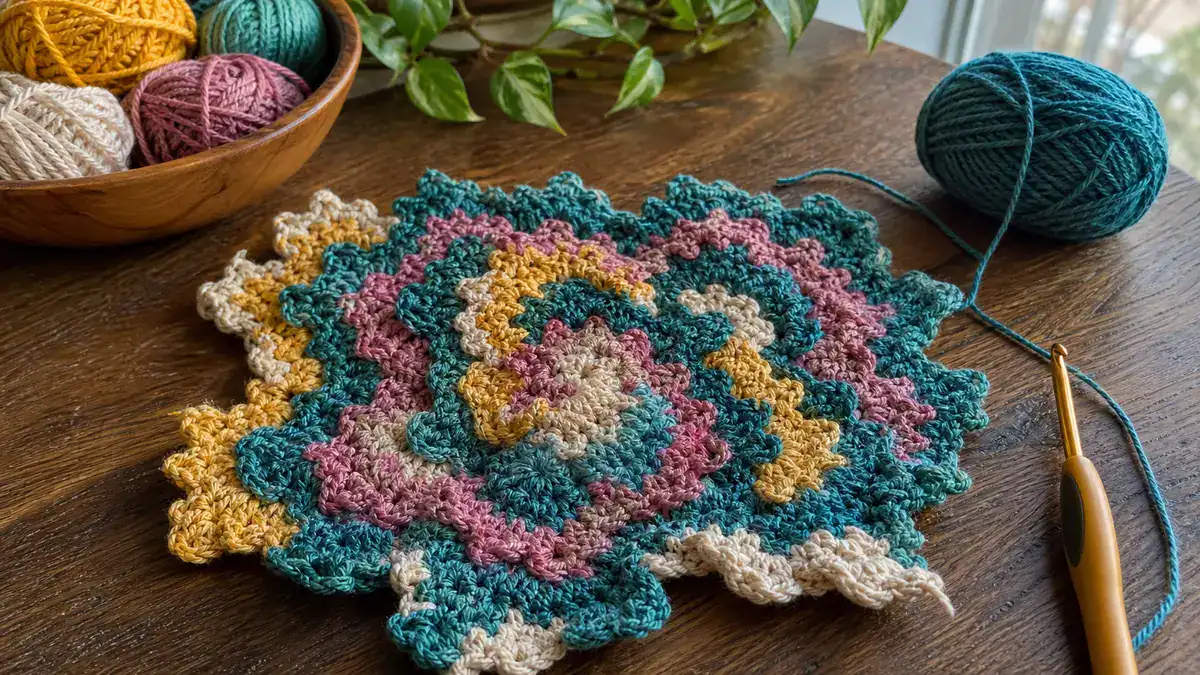
If you’ve ever looked closely at a fern, a snowflake, or a head of romanesco broccoli, you’ve already seen a fractal — you just might not have had a name for it. Fractals are one of those concepts that sound intimidating until you realize you’ve been surrounded by them your whole life. And once you understand how they work, you’ll also understand why crochet is one of the most natural ways to make them.
Don't lose this article. Enter your email below, and I'll send it to you right now. Plus a little crochet inspiration from me, straight to your inbox.
What is fractal crochet? Fractal crochet is any crocheted piece that uses a self-repeating pattern — the same shape or structure appearing at different scales within the same project. Because crochet is built stitch by stitch with consistent repetition, it mirrors the way fractals are mathematically constructed.
What Is a Fractal?
In the simplest terms, a fractal is a never-ending pattern that looks roughly the same no matter how closely or how far away you look at it. Mathematicians call this property self-similarity. Zoom in on one small section, and you’ll see the same structure you saw when you looked at the whole thing.
That might sound abstract, but you already know what fractals look like. An oak tree branches, and each branch branches again in the same way, and each of those branches does the same thing — all the way down to the tiniest twig. Your lungs work the same way. So do river deltas, coastlines, and lightning bolts.
There are a few main types of fractals worth knowing if you want to understand the crochet projects below:
- Branching fractals — a shape that splits and repeats (trees, lungs, river systems)
- Spiral fractals — a curve that grows outward at a consistent ratio (nautilus shells, hurricanes, sunflower seed heads)
- Geometric fractals — a shape that contains smaller copies of itself (the Sierpinski triangle is the classic example)
- Algebraic fractals — generated by repeating a mathematical equation, like the famous Mandelbrot Set
Crochet can model all of these, but geometric and spiral fractals are the most approachable for makers — and they’re where the most interesting patterns live.
Why Crochet and Fractals Are a Natural Pair
Here’s the thing that makes fractal crochet less intimidating than it sounds: the way you build a fractal is essentially the same way you build a crochet pattern. You repeat a unit. You scale it. You repeat it again. If you’ve ever worked a granny square, you’ve already used self-similar logic — the same corner construction repeats at every scale as the square grows.
This is also why I previously wrote about hyperbolic crochet — another mathematical concept that crochet models beautifully because stitches can be increased in every row. Fractals are the next step in that same conversation between math and yarn.
The practical upside for crocheters: many fractal patterns only use a small number of stitches. The complexity comes from the design’s structure, not from learning a dozen new techniques. That makes some of these projects genuinely beginner-friendly, even if they look impressive.
Fractal Patterns Worth Knowing About: A Quick Overview
| Project | Fractal Type | Skill Level | Pattern Availability | Best For |
|---|---|---|---|---|
| Spiral Fractal Table Runner | Spiral | Intermediate | Free (YouTube tutorial) | Home décor, confident beginners |
| Fractal Shawl | Geometric (triangles) | Beginner–Intermediate | Paid (Etsy — verify link) | Wearables, stitch practice |
| Rainbow Fractal Table Runner | Spiral | Intermediate | Paid (Etsy — verify link) | Colorful home décor |
| Sierpinski Triangle Motif | Geometric | Beginner | Various free patterns on Ravelry | First fractal project, math lovers |
| Fractal Crochet Cloud Installation | Branching/organic | Advanced / art installation | Inspiration only | Art and design inspiration |
Spiral Fractal Crochet Table Runner
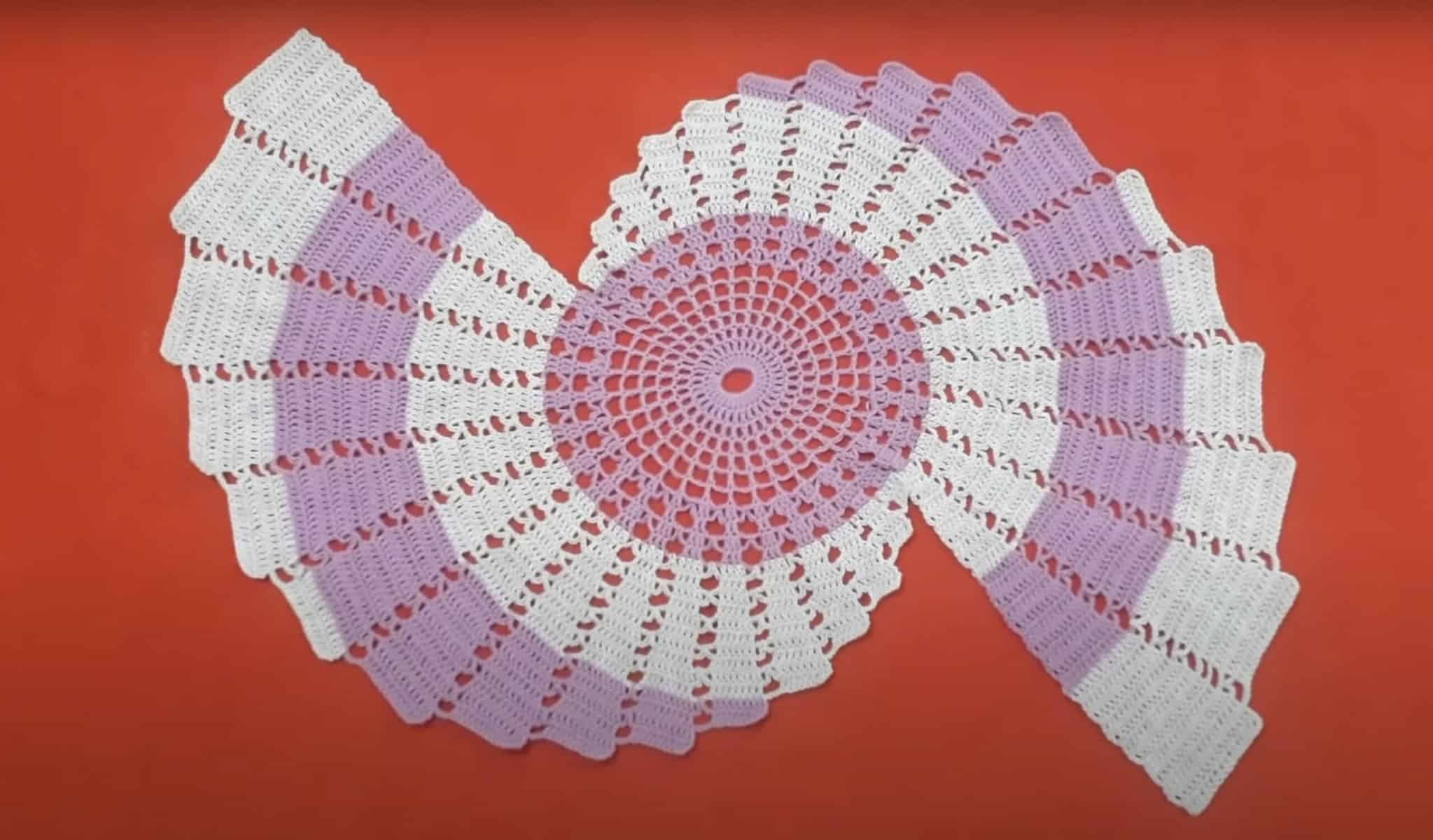
This table runner is a great entry point into fractal crochet because the math is visible in the finished piece — you can actually see the spiral growing as it rotates outward. It works up as a flat doily-style runner, and the pattern is available as a free YouTube tutorial, which makes it easy to follow along at your own pace.
If you’re comfortable with basic increases and working in the round, this is very doable. The trickiest part for most crocheters is keeping the spiral flat as it grows — if it starts to ruffle or cup, check your stitch count at each round before continuing.
Fractal Shawl
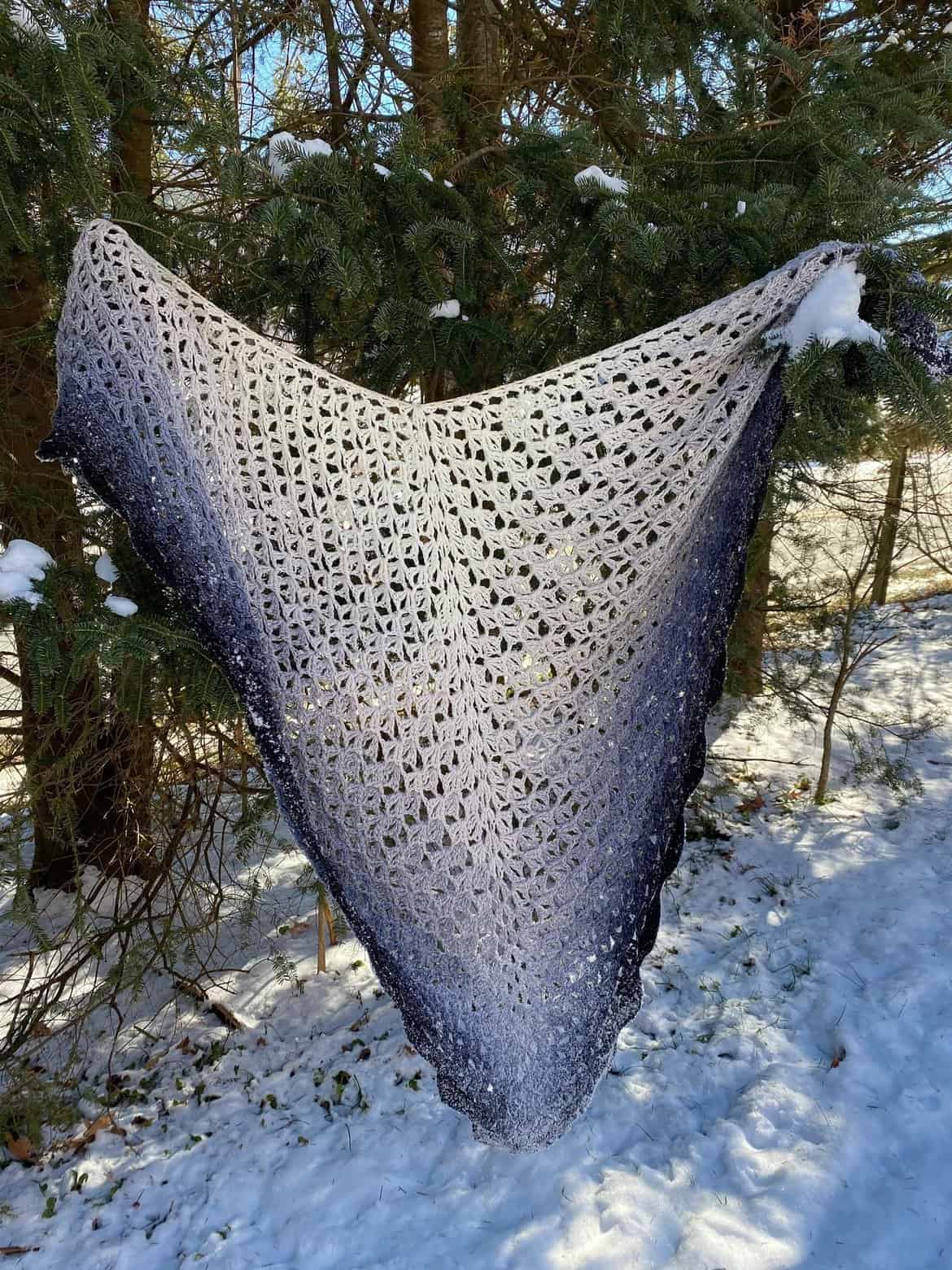
This is the project I’d point a newer crocheter toward first. The fractal structure here is geometric — the shawl is built from triangles that repeat at different scales — and, because of that self-similarity, the pattern calls only for single, double, and triple crochet stitches worked in a consistent sequence. You’re not learning anything new; you’re just repeating what you know in a way that builds into something visually striking.
It’s also a genuinely useful finished object, which matters. A shawl you’ll actually wear is more motivating to finish than a purely decorative piece, especially when you’re still building confidence with a new concept.
Don't lose this article. Enter your email below, and I'll send it to you right now. Plus a little crochet inspiration from me, straight to your inbox.
Note: This pattern was originally listed through an Etsy seller — check the link for current availability before purchasing.
Rainbow Fractal Table Runner
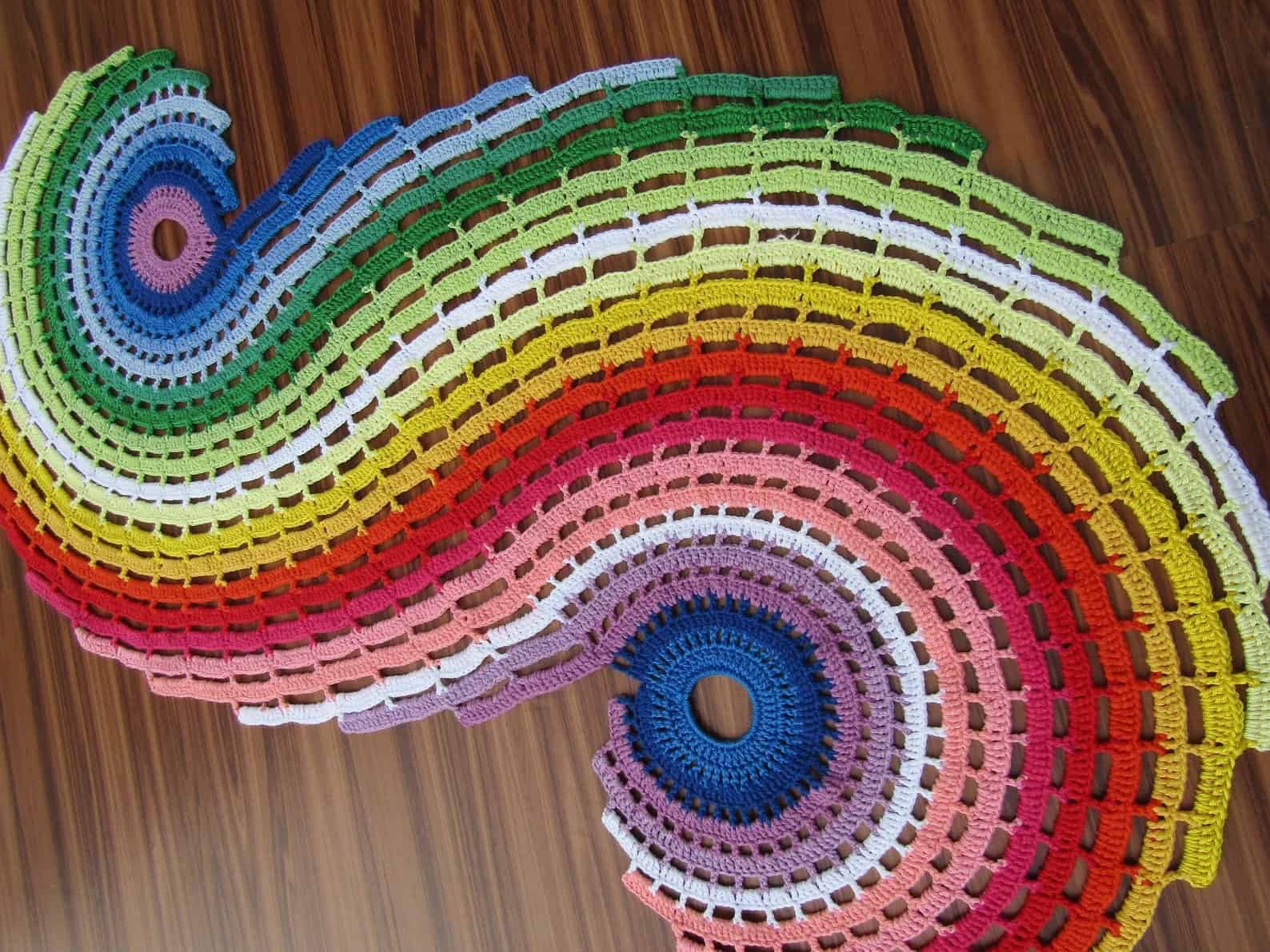
Where the cream spiral runner is subtle and elegant, this one is joyful. The rainbow colorway makes the spiral structure easier to read, which is actually useful if you’re still getting your head around how fractal spirals work — you can see each color band rotating outward and understand the pattern’s logic more intuitively.
This one also has a spiral that goes in two directions, giving it a slightly more complex look than the single-spiral version. It’s a good second project once you’ve tried a simpler spiral piece.
Note: Originally listed through an Etsy seller — verify current availability before purchasing.
The Sierpinski Triangle: The Best First Fractal for Beginners
If you want to try fractal crochet and you’re not sure where to start, the Sierpinski triangle is worth knowing about. It’s one of the most famous geometric fractals — a triangle made of three smaller triangles, each of which is made of three smaller triangles, and so on — and it translates beautifully into crochet motifs.
The crochet community has embraced it enthusiastically. You’ll find Sierpinski triangle squares worked in tapestry crochet, corner-to-corner (C2C) versions, and even granny-square adaptations. Because the pattern is purely geometric and highly repetitive, it’s forgiving for beginners and satisfying to watch as it develops row by row.
Search Ravelry for “Sierpinski,” and you’ll find several free patterns at different skill levels. It’s a good rainy-afternoon project if you want to understand fractal structure through your hands rather than just your eyes.
Fractal Crochet as Art: The Cumulus Cloud Installation
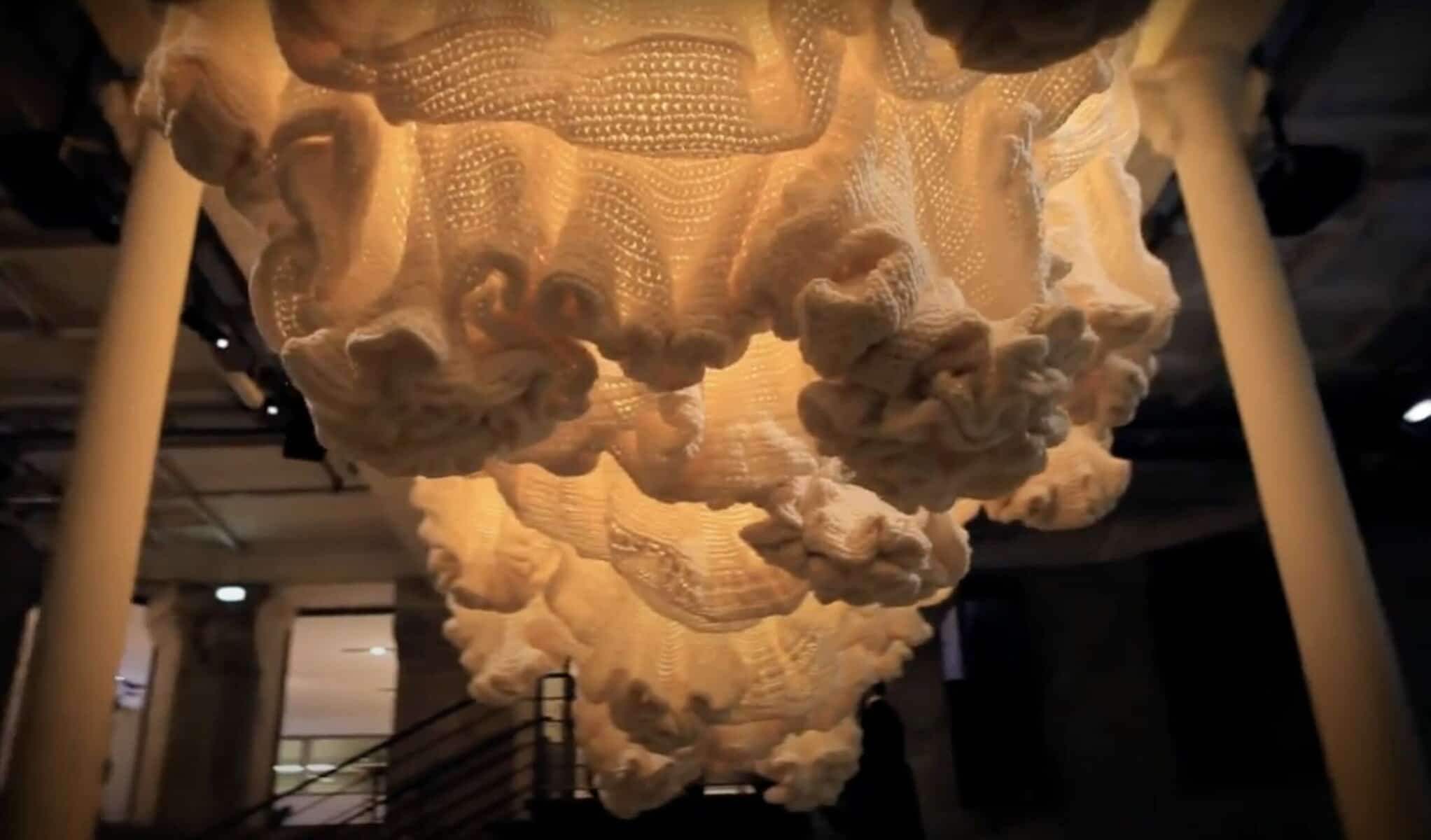
Not every fractal crochet project is something you’ll make at home — and that’s okay. This large-scale installation by Argentinian artist and architect Ciro Najle, titled Cumulus, is worth noting for showing how far the concept can go.
The piece was designed to imitate the fractal branching structure of clouds, and it grew out of a practical engineering project: Najle had been working on fog nets — mesh structures that capture moisture from the air to provide clean water in arid regions. The cloud-like branching of those nets inspired him to reinterpret the structure in crochet as an art form. It’s a good reminder that fractal geometry isn’t just decorative — it shows up in functional design too.
The installation has been displayed in art and design spaces that focus on the intersection of science and creativity. It’s the kind of piece that makes you look at a simple chain stitch differently.
Where to Go From Here
Fractal crochet is one of those topics that starts as a curiosity and tends to become a genuine rabbit hole — in the best way. Once you start seeing self-similar patterns in your existing projects, it’s hard to unsee them.
A few practical starting points depending on where you are right now:
- If you’re a beginner: Start with the fractal shawl or a Sierpinski triangle motif. Both use basic stitches and the repetition is actually helpful for building muscle memory.
- If you’re comfortable working in the round: Try the spiral table runner. The YouTube tutorial format makes it easy to pause and check your work as you go.
- If you want to go deeper: Search Ravelry for “fractal” — the community has been experimenting with branching tree designs, Mandelbrot-inspired colorwork, and C2C geometric fractals that go well beyond what’s shown here.
- If you’re more interested in the math: Look up the Mandelbrot Set and the concept of iteration — the idea that you get complexity by feeding a simple result back into the same equation. That’s exactly what you’re doing every time you repeat a crochet motif at a new scale.
Fractals are, by definition, infinite — but your next project just needs to be one stitch at a time. That part, at least, is very familiar.
LOVE THIS POST! Very cool these fractals! Have you ever made one?
jayalmonte I’ve never crocheted a fractal myself but I feel so inspired to try after creating this roundup!
I saw that pastel fractal flame crochet and almost passed out. I have so got to do this.
How can I obtain the pattern for the Fractal Flame?
That one is just an art piece so to my knowledge there isn’t a pattern for it.
I would love the pattern, where can I get it
On the fractal design when you turn your project-increases- do you pick up two threads for you double crochet or just one. I notice that there is a ridge and I am picking up two threads. Is this right?
I haven’t actually worked any of these crochet fractal patterns myself yet. My assumption would be that you pick up two threads (since it doesn’t say back loop or front loop only).
Me gustaría obtener el patrón guía del arco iris fractal
Me encanta todas estas labores
https://www.etsy.com/in-en/listing/216910929/magnificent-shell-doily-spiral-fractal?ref=related-2
I just got the pattern for the fractal doily and am wondering if the people that did each vane in a different color did them separately or changed colors at each different one? hope that made sense